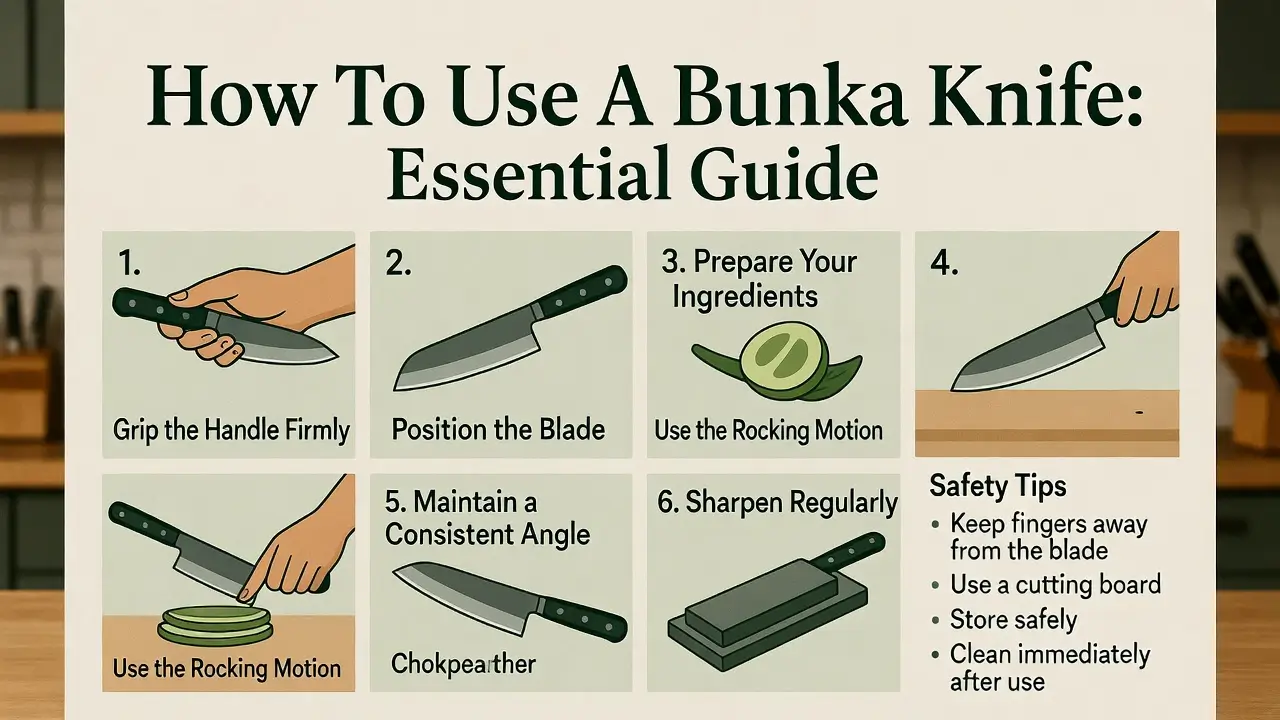
Use a bunka knife for clean, precise slicing, push cuts, and quick vegetable prep with control.
I have used a bunka knife in professional and home kitchens for years, and I will show you how to use a bunka knife safely and well. This guide explains why the bunka shines, breaks down the blade and handle, gives a clear step-by-step on technique, and shares care tips and real-life examples. Read on to master how to use a bunka knife with confidence and speed.

Why choose a Bunka knife
A bunka knife blends the nimble edges of a petty knife with the flat utility of a nakiri. The blade geometry and tip make it ideal for vegetables, trimming, and precise cuts. Many cooks prefer a bunka knife because it handles push cuts, pull cuts, and light chopping without switching tools. Choose a bunka when you want one blade that handles prep, trimming, and fine finishing.

Source: cutleryandmore.com
Bunka knife anatomy and what makes it unique
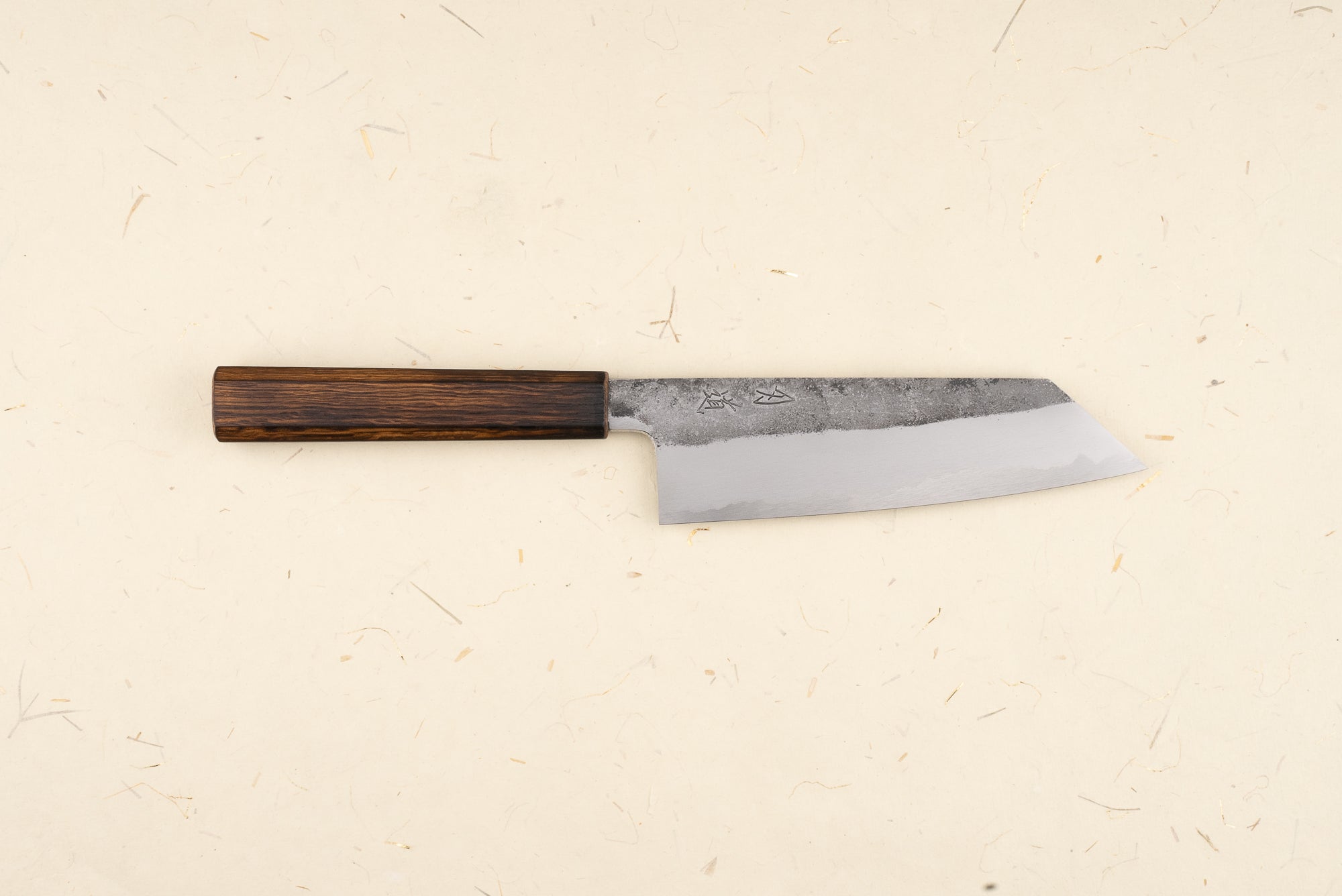
A bunka knife typically has a tall, slightly angled blade and a sharp triangular tip. The blade height gives knuckle clearance and a flat surface for scooping. The angled tip helps with intricate work like scoring, trimming, and puncturing. Many bunka blades have a single bevel or double bevel finish and can be made from stainless or carbon steel. Knowing the anatomy helps you tailor technique and maintenance.

Source: knifewear.com
How to use a bunka knife: step-by-step guide
Follow these steps to learn how to use a bunka knife for everyday prep.
- Inspect the knife and board.
- Ensure the blade is sharp and free of nicks.
- Use a stable, non-slip cutting board.
- Adopt a proper grip.
- Pinch the blade where it meets the handle with thumb and forefinger.
- Wrap the remaining three fingers around the handle for control.
- Position the food and guide hand.
- Use your non-dominant hand as the guide, curling fingertips inward.
- Place the knuckles as a stop against the blade.
- Start with basic push cuts.
- Place tip slightly forward and push the blade forward into the food.
- Draw back slightly and repeat for thin slices.
- Use the tip for trimming and scoring.
- Use the angled tip for detail work like removing cores or scoring meat.
- Perform rocking or chopping for larger veg.
- Use a short rocking motion with the tip anchored when chopping herbs.
- For heavier chopping, use the flat of the blade with straight down pressure.
- Clean and store after use.
- Wipe the blade, dry it, and store it safe to protect the edge.
Mastering these steps shows you exactly how to use a bunka knife for most kitchen tasks. Repeat these movements slowly at first, then build speed and accuracy.

Source: knifewear.com
Essential cutting techniques with a bunka knife
The bunka adapts to many cutting styles. Practice these core techniques.
- Slicing
- Use long, smooth strokes. Let the blade do the work.
- Push cutting
– Push forward with the blade while guiding the food with knuckles. - Pull cutting
- Pull the knife toward you for dense items or precision slices.
- Rock-chop
- Anchor the tip and rock the blade to mince herbs or garlic.
- Julienne and batonnet
- Use steady, thin slices to create uniform matchsticks quickly.
- Scoring and trimming
- Use the pointed tip to make shallow cuts or remove membranes.
People also ask: What is the difference between a bunka and a santoku?
- A bunka has a sharper, angled tip for detail work and more pronounced blade height. A santoku has a blunter tip and a flatter profile for general slicing and chopping.
People also ask: Can I use a bunka knife for meat?
- Yes. The bunka can trim and portion meat, though for heavy bone work a cleaver or boning knife is better. Use the tip for fine trimming and the flat for slicing.

Source: japanese-food-craftsman.com
Sharpening, care, and maintenance
A sharp bunka knife performs safer and cleaner cuts. Here’s how to keep it sharp.
- Hone before each use
- Use a honing rod to realign the edge with five to ten light strokes per side.
- Sharpen on a whetstone
- Use a 1000-grit stone for regular sharpening and a 3000–6000 grit for finishing.
- Maintain the correct angle, usually 15–20 degrees per side for double-bevel blades.
- Clean and dry
- Wash by hand with mild soap and dry immediately to prevent rust.
- Oil carbon steel blades
- If your bunka is carbon steel, apply a light food-safe oil after drying.
- Store safely
- Use a magnetic strip, blade guard, or knife block to protect the edge.
Learning how to use a bunka knife includes learning how to care for it. I sharpen mine weekly when in heavy use, and that keeps tasks effortless.
Source: knifewear.com
Safety tips and common mistakes to avoid
Safety keeps practice enjoyable and consistent.
- Keep fingers curled and knuckles forward to avoid cuts.
- Do not use a bunka to pry or cut frozen food or bone.
- Avoid cutting on glass or stone boards that dull the edge quickly.
- Do not put the knife in the dishwasher; heat and detergent damage the handle and blade.
- Respect the tip; the pointed end is sharp and can puncture easily.
A common mistake is using too much force. A sharp bunka cuts with little pressure. Overpressing leads to slips and uneven cuts. I learned this early: let the blade slice, do not muscle it.

Source: cutleryandmore.com
Personal tips, real-life examples, and simple recipes
I use a bunka knife every day for veg prep and quick dinner tasks. It excels for:
- Making thin carrot ribbons for salads.
- Quick julienne for stir-fries.
- Trimming fish fillets and scoring skin.
Personal tip: when cutting onions, slice root to tip with the bunka tip first, then use a steady push cut to avoid smashing layers. I found this reduces tears and gives even slices. Start with small practice tasks like herbs and soft veg to get feel for the blade.

Source: sharpedgeshop.com
Frequently Asked Questions of how to use a bunka knife
What is the best grip for a bunka knife?
Pinch the blade where it meets the handle with thumb and forefinger, and wrap the other fingers around the handle. This grip gives control for both fine and heavy cuts.
Can a bunka replace other knives?
A bunka is versatile and can replace several knives for prep work, but it is not ideal for heavy bone work or filleting large fish. Use it for vegetables, trimming, and slicing.
How often should I sharpen a bunka knife?
Hone the knife before each use and sharpen on a whetstone when you notice dullness, typically every few weeks with regular use. Frequency depends on blade material and load.
Is a bunka good for beginners?
Yes. The bunka’s height and tip make it forgiving and versatile, which helps beginners learn multiple cutting techniques with one blade. Start slowly and focus on grip and safety.
Should I use a whetstone or a pull-through sharpener?
A whetstone provides better, longer-lasting edges and control, while a pull-through sharpener is quicker but more abrasive. For best care, learn to use a whetstone.
Conclusion
Mastering how to use a bunka knife gives you a single tool that speeds prep and boosts precision. Start with safe grips, practice push and pull cuts, keep the blade sharp, and avoid heavy tasks the bunka was not designed for. Try simple daily drills—slicing onions, julienne carrots, and mincing herbs—to build confidence. If you practice consistently, you will see faster, cleaner prep and enjoy cooking more. Share your practice wins or questions below, and subscribe for more knife guides and kitchen tips.
Maliha Khatun has spent 5 years hands-on testing Japanese knives for everyday home cooks. She has evaluated over 60 blades across nakiri, santoku, gyuto, and petty categories — scoring each on edge retention, steel quality, handle comfort, and value for money. She writes to help home cooks buy the right knife without the guesswork.
Expertise:Japanese Knives • Vegetable Knives • Product Reviews • Kitchen Efficiency • Knife Care
Leave a Reply