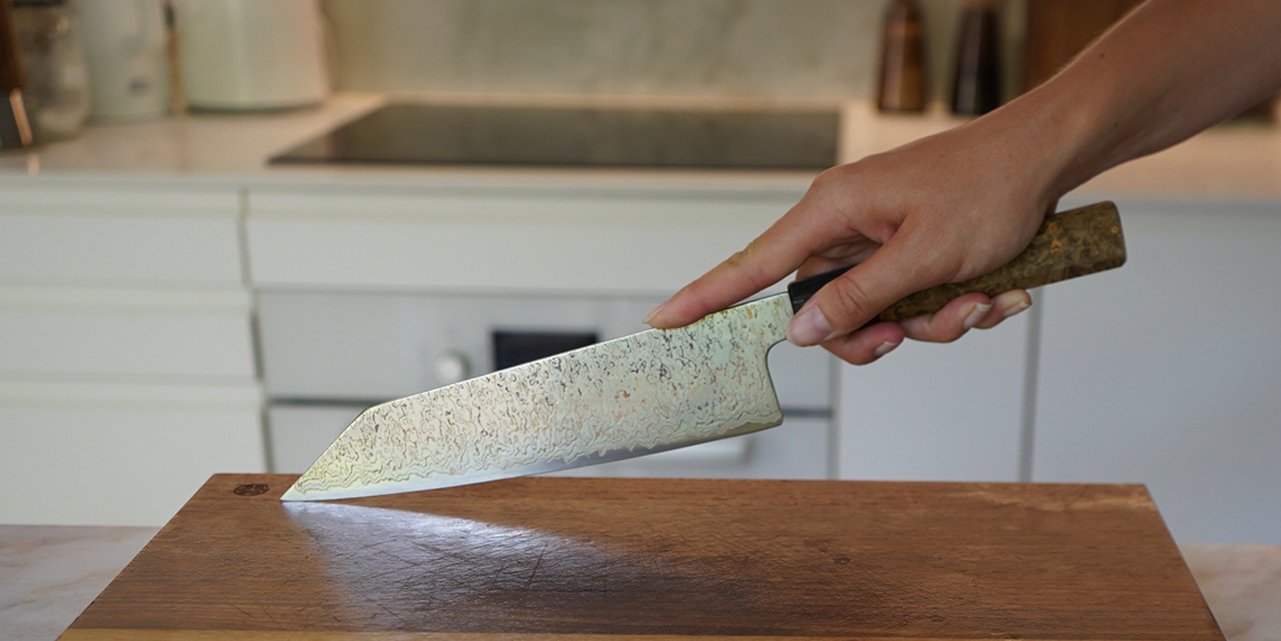
The best knife for arthritis is one that needs less grip strength and keeps your wrist straight: a sharp blade, a thick non-slip handle, and a design such as a vertical-handle or rocker knife that lets you cut by pressing down instead of squeezing and sawing.
Arthritis can make everyday kitchen tasks like slicing bread or chopping vegetables painful. The right knife, or a simple adaptation to the knives you already own, can reduce the effort involved. This guide explains which features matter, the main types of arthritis-friendly knives, and how to test one before you buy.
This article is general information, not medical advice. An occupational therapist can assess your hands and recommend tools for your specific needs.

Why the right knife helps with arthritis
A standard knife makes you grip a narrow handle tightly and push or saw with your wrist bent. For sore or stiff joints, that combination of tight grip and wrist movement is often what causes pain. A better-designed knife spreads the force across your whole hand, keeps the wrist in a more neutral position, and lets you use arm or body weight instead of finger strength.
Features to look for in a knife for arthritis
- A thick, cushioned handle: A larger handle is easier to hold with a weak or painful grip than a thin one.
- A non-slip surface: Rubber or textured handles stay secure even if your grip is light or your hands are damp.
- A neutral wrist position: Vertical (upright) handles and angled handles let you cut with your wrist straight, pressing down with your arm.
- Light weight: A lighter knife is less tiring to lift and control.
- A sharp edge: A sharp blade cuts with much less force than a dull one. Keeping your knives sharp is one of the simplest ways to make cutting easier.
- A shorter blade: A utility or santoku-length blade is easier to control than a long chef’s knife.
Types of arthritis-friendly knives and tools
Vertical-handle (upright) knives
The handle sits above the blade, like holding a saw or a dagger pointed down. You hold it in a fist with your wrist straight and press down. Many people find this the most comfortable option for slicing.
Rocker and T-handle knives
A rocker knife has a curved blade that you rock back and forth with downward pressure, often with a T-shaped handle on top. It needs little sawing motion and is useful for chopping and for cutting food on a plate.

Knives with built-up handles
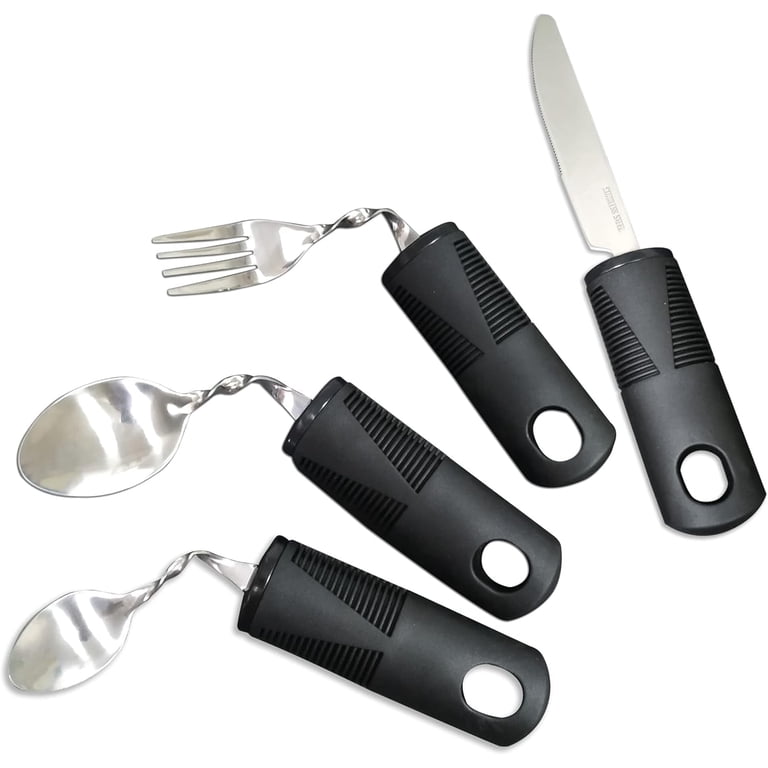
Some adaptive knives come with thick, weighted, or soft built-up handles, often sold as part of a utensil set. They work like a regular knife but are easier to grip.

Electric knives
An electric knife does the sawing for you, which helps with bread and roasts. They are heavier than ordinary knives and need careful handling, so try lifting one before relying on it.
Other helpful tools
- Kitchen shears with spring-loaded handles: Good for herbs, scallions, and trimming.
- Food choppers and pre-cut ingredients: Reduce how much cutting you need to do.
- Cut-resistant gloves: Add protection for the hand holding the food.
Adapt the knives you already have
- Slide foam tubing or a silicone handle sleeve over a thin handle to make it thicker and softer.
- Keep your knives sharp so they need less pressure. Our guide on how often to sharpen knives explains when to do it, and this guide covers the right Japanese knife sharpening angle.
- Choose a smaller, lighter knife for everyday jobs instead of a heavy chef’s knife. A petty knife is a good option; see our petty knife guide.
How to test a knife before you buy
- Hold it for a minute. Notice whether you need to squeeze hard to keep control.
- Check your wrist. When you mimic a cut, your wrist should stay fairly straight, not bent sharply up or down.
- Feel the weight. Lift it several times. If it tires your hand quickly, try something lighter.
- Try a soft cut if possible. A tomato or bread shows how much pressure the knife needs.
- Check the return policy. Comfort is personal, so buy where you can return a knife that does not suit you.
Safer cutting habits
- Put a damp towel or non-slip mat under your cutting board so it does not move. A good board also protects the edge; see our guide to the best cutting board for knife care.
- Sit down to prep if standing is tiring.
- Cut food into a flat, stable shape first so it does not roll.
- Take breaks during long prep sessions.
- Store knives in a block or on a magnetic strip so you do not have to reach into a drawer of loose blades.
For more general advice, read our knife safety in the kitchen guide.
Frequently asked questions
What type of knife is easiest to use with arthritis?
Many people find vertical-handle knives and rocker knives easiest, because they let you cut by pressing down with a straight wrist instead of gripping tightly and sawing.
Can I make my current knives easier to hold?
Yes. Foam tubing or silicone handle sleeves make thin handles thicker and softer. Keeping the blades sharp also reduces the force you need.
Are electric knives good for arthritis?
They reduce sawing effort, which helps with bread and roasts, but they are heavier than regular knives. Test the weight before buying.
Is a heavier or lighter knife better?
For most people with arthritis, lighter is easier, as long as the knife is sharp and the handle is comfortable. A very light knife with a thin handle can still be hard to grip.
Who can help me choose adaptive kitchen tools?
An occupational therapist can assess your hands and suggest specific tools and techniques for your situation.
Conclusion
A good knife for arthritis reduces the grip strength and wrist bending that make cutting painful. Look for a sharp blade, a thick non-slip handle, and a design such as a vertical-handle or rocker knife. Adapting the knives you already own with thicker grips and regular sharpening can also help. Try a few options and choose the one that feels comfortable in your hand. For more guides, browse our knife guides.
Maliha Khatun has spent 5 years hands-on testing Japanese knives for everyday home cooks. She has evaluated over 60 blades across nakiri, santoku, gyuto, and petty categories — scoring each on edge retention, steel quality, handle comfort, and value for money. She writes to help home cooks buy the right knife without the guesswork.
Expertise:Japanese Knives • Vegetable Knives • Product Reviews • Kitchen Efficiency • Knife Care
Leave a Reply