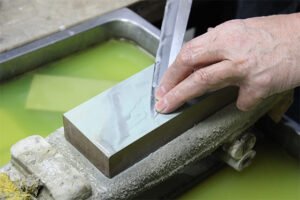
HRC measures how deep a diamond indents steel under load.
If you work with knives, tools, or gears, you need Hardness rating (HRC) explained in plain words. I’ve tested and specified hardness on shop floors and in labs. This guide shares how HRC works, why it matters, and how to use it with confidence. By the end, Hardness rating (HRC) explained will feel simple, practical, and useful.

What is HRC and the Rockwell hardness test?
HRC stands for Rockwell C hardness. It is a number that tells how resistant a metal is to a diamond cone pressing into it. The deeper the dent, the lower the HRC. The shallower the dent, the higher the HRC.
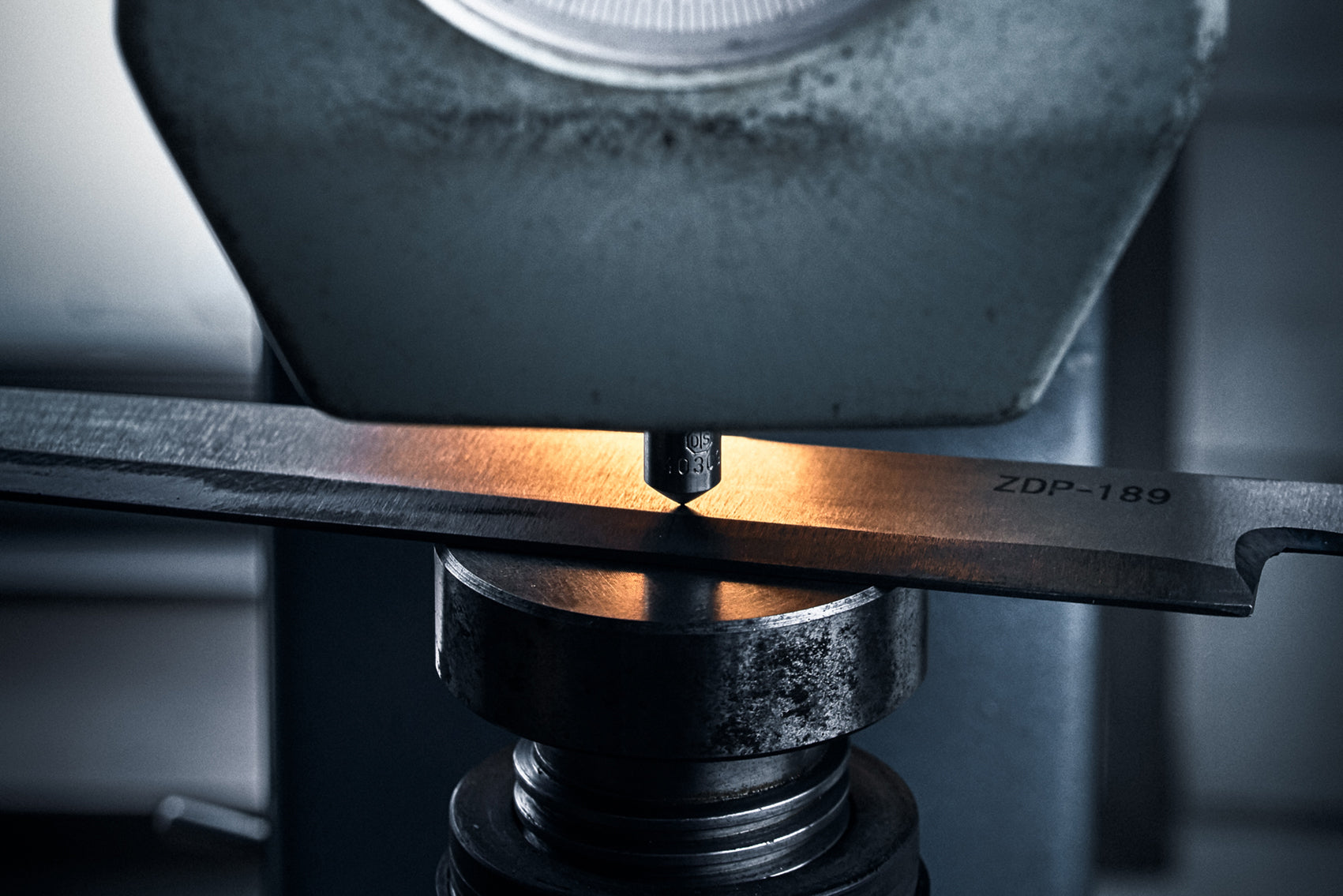
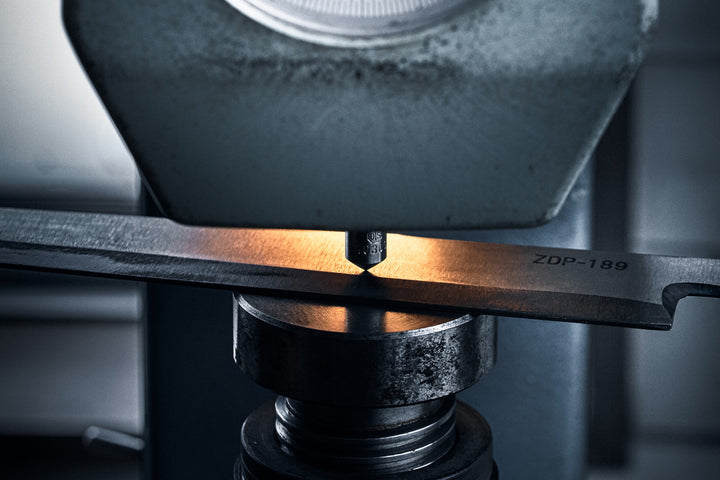
The Rockwell C scale uses a diamond cone called a conical indenter. The test uses two loads: a small minor load and a larger major load. The machine measures depth change under load. That depth translates into the HRC number.
Hardness rating (HRC) explained gives you a fast way to compare steels. It links to strength, wear life, and heat-treat results. It is the default scale for many carbon and alloy steels.

Source: nobliecustomknives.com
How the Rockwell C test works, step by step
Understanding the steps makes Hardness rating (HRC) explained feel easy. Here is the simple flow.
Prepare the sample
The test face must be clean and flat. It should be smooth, usually ground to a fine finish. The part must be thick and large enough to avoid edge or thickness effects.Apply the minor load
The machine applies a minor load, usually 10 kgf. This sets a zero point. It helps cancel surface irregularities.Apply the major load
The machine increases to a total of 150 kgf on the Rockwell C scale. The indenter sinks to a depth based on the metal’s resistance. Dwell time is held for seconds to stabilize.Read the hardness
The major load is removed, leaving the minor load applied. The machine reads the depth change. That depth maps to the HRC value. A shallower depth equals a higher HRC.
In short, Hardness rating (HRC) explained is a depth-based hardness number. It is direct, fast, and repeatable when you follow standards. It also limits operator error compared to scratch or rebound tests.
Source: sharpedgeshop.com
HRC vs other hardness scales
The Rockwell system has many scales. HRC uses a diamond and 150 kgf, ideal for hard steels. HRB uses a steel ball and 100 kgf, better for softer metals. HRA uses the diamond but a lower load.
You may also see Vickers (HV), Brinell (HB), and Mohs scales. HV uses a diamond pyramid and works across a wide range. HB uses a ball and load and is common for castings. Mohs is a scratch scale and is not used for engineering specs.
Hardness rating (HRC) explained often includes conversion talk. Conversions are estimates, not exact. Microstructure and heat treat can skew conversions. When in doubt, test on the same scale as your spec.
Source: agrussell.com
Why HRC matters in real life
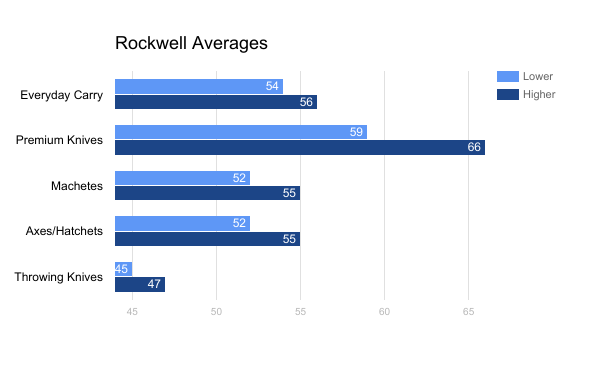
HRC tells you if a tool will hold an edge or chip in use. It helps you balance wear life against toughness. It guides heat treat targets and quality checks. And it lets buyers compare steels across makers.
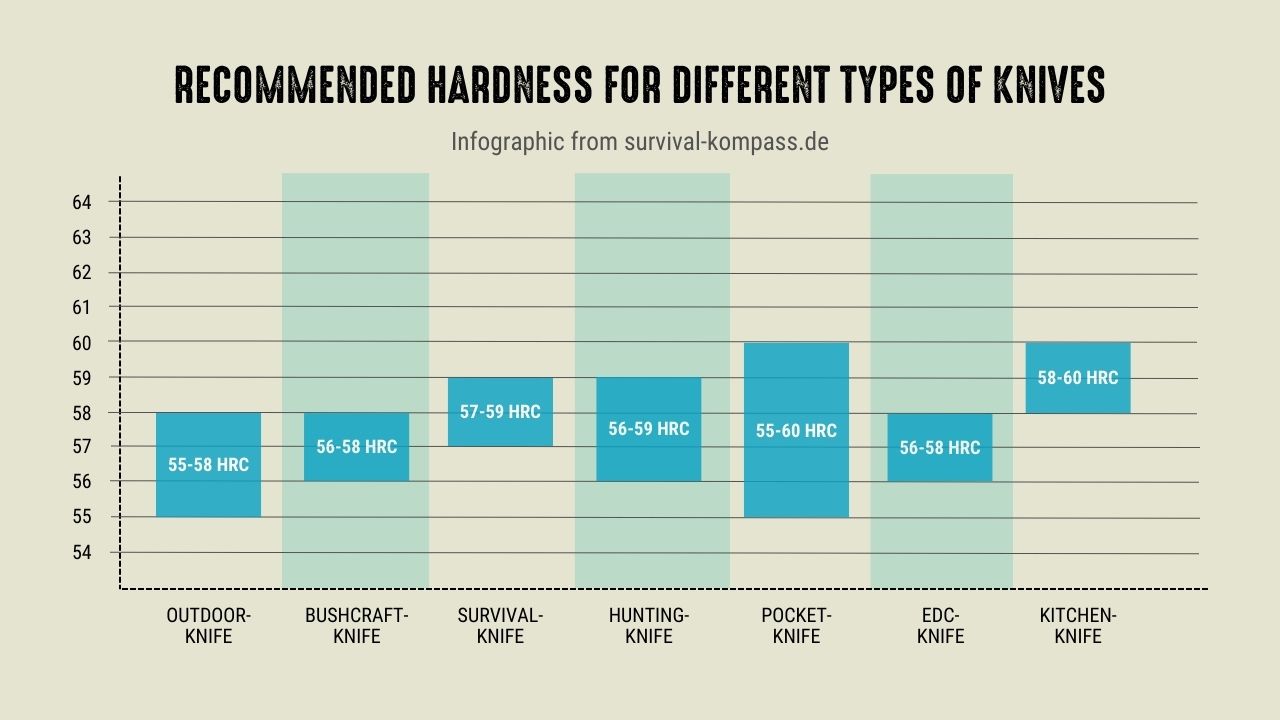
Here are common HRC ranges by use case:
- Kitchen knives: 56 to 62 HRC for a balance of edge and toughness.
- Pocket knives: 58 to 64 HRC depending on steel and edge style.
- Cold work dies and punches: 58 to 62 HRC for wear and strength.
- Gears and shafts (case hardened): surface 58 to 64 HRC with a tough core.
- Bearings and races: about 60 to 66 HRC for rolling contact life.
I have seen blades at 64 HRC chip in the field. After tempering down to 60 HRC, they held up better. That is Hardness rating (HRC) explained in practice: fit the number to the job, not the other way around.

Source: sciencedirect.com
Choosing and verifying the right HRC for your project
Start with the end use. Ask what fails first: wear or breakage. Then pick a hardness window that avoids the failure mode. Hardness rating (HRC) explained should always include real-world stress.
Follow this simple plan:
- Define the service: cutting, impact, rolling, or sliding.
- Check steel datasheets for recommended HRC ranges.
- Specify the target range, not a single number, like 58 to 60 HRC.
- Heat treat with proper austenitize, quench, and temper steps.
- Test with Rockwell C on representative spots, not just one.
A quick tip from my work: verify temper right after quench and after final temper. I once caught a temper oven drift that cost two points of HRC. That saved a batch of punches from early failure. Hardness rating (HRC) explained is also about tight process control.
Source: survival-kompass.de
Factors that influence HRC results
Small details can change readings a lot. Keep these in mind before you trust the number.
- Surface finish: Rough grinding causes erratic depth. Use a fine finish near the test site.
- Thickness: Thin parts flex and give false low HRC. Keep enough thickness under the indent.
- Decarburization: Soft decarb on the surface lowers HRC. Grind past decarb before testing.
- Case depth: For case-hardened parts, test near the correct depth. Surface-only tests can mislead.
- Residual stress and microstructure: Martensite, bainite, and retained austenite affect HRC. So does stress from machining or quench.
- Temperature: Test near room temperature for stable results.
To keep Hardness rating (HRC) explained truthful, control the test site. Space indents far enough apart and away from edges. Follow the machine’s maintenance schedule so the indenter and loads stay in spec.
Source: sharpedgeshop.com
Interpreting HRC numbers: the strength and toughness trade-off
Higher HRC usually means higher strength and wear resistance. But it often means lower toughness. Think of it like glass versus rubber. The glass is hard but brittle. The rubber is tough but soft.
For edges and dies, you seek the sweet spot between chipping and dulling. A hunting knife at 58 to 60 HRC may be ideal. A wood chisel used on knotty hardwoods might need a touch less to avoid chip-out.
Hardness rating (HRC) explained is not only about a high score. It is about the right score for the job. Match the hardness to the load, impact risk, and environment. Add coatings or surface treatments if you need extra wear without raising core HRC.
Common myths about HRC
There are many myths out there. Let’s clear a few.
Myth: Higher HRC is always better.
Reality: Higher HRC can chip. Balance with toughness for the task.Myth: Two steels at 60 HRC perform the same.
Reality: Carbides, alloy content, and microstructure matter a lot.Myth: You can convert HRC to any scale exactly.
Reality: Conversions are approximations and can be off for certain steels.Myth: One indent tells the whole story.
Reality: Take multiple indents and average. Map different zones if needed.Myth: HRC equals sharpness.
Reality: HRC affects edge retention, not raw sharpness. Geometry and finish matter.
Hardness rating (HRC) explained gets clearer when you drop the myths. Use data and tests, not hype or single numbers.
Testing best practices and standards
Use a calibrated Rockwell tester for reliable results. Follow recognized standards that define methods, loads, and dwell times. Keep the indenter clean and unworn, and verify daily with test blocks.
Follow these best practices:
- Level the machine and set the correct scale: HRC, not HRB.
- Use proper anvil support so the part does not tilt or flex.
- Make three to five indents and average the middle values.
- Keep indents away from edges and from each other.
- Recheck after tempering or surface finishing steps.
When you apply standards, Hardness rating (HRC) explained becomes repeatable across shops. It turns into a trusted spec, not just a number on a chart.
Frequently Asked Questions of Hardness rating (HRC) explained
What does an HRC number actually mean?
It is a measure of depth from a diamond indentation under load. A higher HRC means less indentation and a harder material.
Is HRC the same as steel strength?
Not exactly, but higher HRC often correlates with higher strength. Strength also depends on microstructure and heat treatment.
Can I convert HRC to HV or HB accurately?
Conversions are only estimates. Test on the same scale as your spec for critical parts.
What HRC is good for a kitchen knife?
Most quality kitchen knives sit between 56 and 62 HRC. Choose based on steel type and how you sharpen.
Why do two 60 HRC steels perform differently?
Carbides, alloy content, and heat-treatment quality change wear and toughness. Edge geometry and finish also play big roles.
How many HRC tests should I do on a part?
Take at least three and average them, unless a standard says otherwise. Map key zones if hardness varies through the part.
Does HRC tell me about corrosion resistance?
No, HRC measures hardness, not corrosion. Choose alloys and finishes for rust control.
Conclusion
Hardness rating (HRC) explained gives you a fast, reliable window into steel performance. It links heat treat, wear life, and toughness in one clear number. Use it to set targets, verify parts, and choose materials with confidence.
Put this into action today. Set a hardness range for your next project, test it well, and record what works in the field. If this helped, subscribe for more guides, ask a question, or share your own HRC lessons.

Emily Carter is a kitchen knife specialist with over 8 years of experience testing and reviewing Japanese kitchen knives. She focuses on blade performance, comfort, durability, and real-life cooking usability. Her goal is to help home cooks choose reliable, high-quality knives for everyday cooking.
Expertise: Japanese Knives, Vegetable Cutting, Product Testing