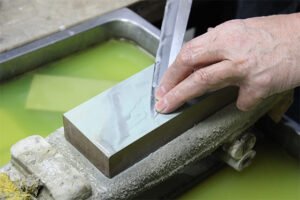
Straight edge offers precise cuts and control; curved edge gives smoother slicing and better ergonomics.
I’ve tested knives, razors, and woodworking tools for years. I know how small edge changes affect performance. This article explains straight edge vs curved edge in clear terms. You will get definitions, real-world examples, pros and cons, and practical buying and maintenance tips. Read on to choose the right edge for your work or hobby.

What Are Straight Edge and Curved Edge?
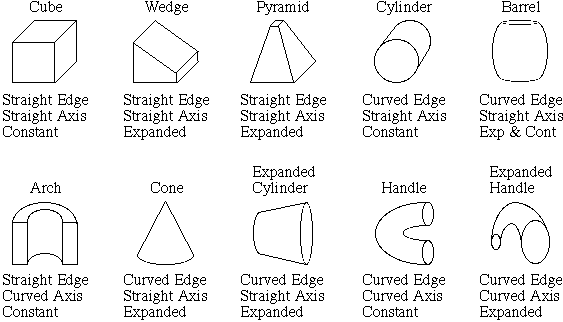
A straight edge is a blade or rim that runs in a nearly linear line. It meets the workpiece with a consistent angle. A curved edge bends along its length. That shape changes how the edge contacts material and how cuts begin and end.
Applications vary. Straight edge vs curved edge shows up in knives, straight razors, woodworking planes, chisels, and even screen glass. Each context shifts the design trade-offs. Understanding the basic definitions helps you choose the right tool for the task.
Design Differences and How They Affect Use
Straight edge vs curved edge differences start with geometry. Straight edges have long, flat bevels. Curved edges have radiused profiles or belly shapes.
Key mechanical differences:
- Contact pattern: Straight edges touch along a line. Curved edges touch at a point or short segment.
- Cutting stroke: Straight edges favor push or chop moves. Curved edges favor draw or sweep cuts.
- Control: Straight edges give precise, predictable cuts. Curved edges allow fluid slicing and continuous contact.
- Tip behavior: Straight tips pierce directly. Curved tips slice gradually.
These differences matter for how you hold the tool, the angle you use, and how much force you apply. That is the central theme in straight edge vs curved edge decisions.
Performance Comparison: Sharpness, Control, and Comfort
Sharpness and edge retention are similar when materials match. But feel and efficiency change with shape.
Sharpness and cutting:
- Straight edge vs curved edge both get very sharp. Edge geometry and steel determine retention more than shape.
- Curved edges tend to slice thin layers with less force. Straight edges excel at clean, straight cuts.
Control and ergonomics:
- Straight edge tools feel stable. They help beginners learn straight cuts.
- Curved edge tools feel natural for rocking or slicing motions. They reduce wrist strain in repeated tasks.
Comfort and fatigue:
- Use a curved edge for long, repetitive cuts to lower fatigue.
- Use a straight edge for precision tasks that need alignment and repeatable motion.
Use Cases: When to Choose Straight Edge or Curved Edge
Choosing between straight edge vs curved edge depends on the task. Here are common use cases.
When to pick straight edge:
- Carpentry and layout where straight lines matter.
- Cleaving and chopping where direct force is required.
- Tools like chisels, planes, and utility knives for straight cuts.
When to pick curved edge:
- Kitchen knives for slicing meat, fish, and vegetables.
- Straight razors and safety razors with a slight curve for smooth shaves.
- Scissors and shears where a curved profile helps follow contours.
Practical examples:
- Cutting cardboard and drywall often uses straight edge blades for clean straight lines.
- Filleting fish works best with a curved belly for long slicing strokes.

Materials, Maintenance, and Longevity
Material choice affects performance more than shape most times. High-carbon steel, stainless alloys, and ceramic behave differently.
Maintenance tips:
- Sharpen straight edge vs curved edge differently. Use a flat stone or guided sharpener for straight edges. Use a curved stone or flexible strop for curves.
- Hone curved edges with small radius motions to maintain the belly.
- Use proper angle guides. Straight edges often use fixed angles. Curved edges need variable angle control along the curve.
Longevity notes:
- Edge wear concentrates where the edge contacts the work. Curved edges may wear unevenly if used improperly.
- Regular stropping helps both types maintain performance.

Personal Experience and Practical Tips
I have used both edges in kitchens and workshops. I once switched a carving knife from a straight profile to a curved belly for a week. Cuts became faster and cleaner for sashimi. I learned to adjust my wrist motion. That small change halved my effort for the same result.
Practical tips from my work:
- Match motion to shape. Slice with curved edges. Push or chop with straight edges.
- Don’t force a straight technique on a curved blade. It wastes energy and dulls the edge.
- Try both on a cheap model before spending on high-end tools.
Mistakes to avoid:
- Using a straight edge for rounded contours.
- Sharpening a curved edge on a flat stone without adjusting technique.
- Ignoring ergonomics; a bad handle ruins both designs.
Common Misconceptions and Limitations
Misconception: Curved edges are always better for slicing.
- Reality: Curved edges help slicing but depend on steel and profile. For straight cuts, they can be worse.
Misconception: Straight edges are easier to sharpen.
- Reality: Straight edges are easier on flat stones, but curved edges can be easier on small stones or hones once you learn the motion.
Limitations:
- Straight edge vs curved edge both trade off control, contact area, and ease of sharpening.
- Neither solves poor technique. Training matters as much as shape.
- Specific tasks may require hybrid profiles that combine straight and curved sections.

PAA-style Quick Questions
What is the main difference between straight edge and curved edge?
- The main difference is how the blade contacts material: straight edges meet along a line, curved edges meet along a point or small segment, changing cut style.
Which edge is better for beginners?
- Straight edge tools are often easier for beginners because they make predictable straight cuts and teach alignment.
Can you sharpen both edge types at home?
- Yes. Straight edges suit flat stones and guided sharpeners. Curved edges need flexible stones or careful stropping to match the radius.
Do curved edges dull faster?
- Not necessarily. Dulling depends on steel, use, and maintenance. Curved edges can show uneven wear if misused.
Is one edge safer to use?
- Safety depends on technique and task. Curved blades may be safer for controlled slicing, while straight blades reduce unexpected tip slips in some tasks.

Frequently Asked Questions of straight edge vs curved edge
What is the best edge for kitchen work?
For general kitchen tasks, a curved edge works well for slicing and rocking motions. Straight edges are better for push cuts and precise chopping.
How does sharpening differ between straight and curved edges?
Straight edges use flat stones and consistent angles. Curved edges need rounded or flexible stones and variable angle control along the curve.
Can a straight edge be converted to a curved edge?
You can grind a straight blade to add a belly, but it requires skill. Incorrect grinding can weaken the blade or harm its geometry.
Which edge is better for shaving?
A slightly curved straight razor often gives a smoother shave because it follows facial contours. The blade type and angle are key.
Are there hybrid edges that combine both shapes?
Yes. Many tools use a hybrid edge with a straight section near the heel and a curved belly near the tip for versatile performance.
How do I decide between straight edge vs curved edge for woodworking?
Pick straight edges for joinery and layout. Choose curved edges for shaping and carving where contours matter.
Do curved edges require different maintenance in a professional setting?
Yes. Professionals often use strops and shaped stones for curved edges and set maintenance routines based on the profile.
Conclusion
Choosing between straight edge vs curved edge comes down to the work you do, your motion, and your maintenance routine. Both shapes have clear strengths. Straight edges give control and predictability. Curved edges offer smooth slicing and less wrist strain. Test both designs on simple tasks and match your technique to the edge. Try a low-cost trial tool, practice the proper sharpening method, and pick the edge that fits your daily work.
Take action: test a straight edge and a curved edge on a small project this week. Note which feels better and how you sharpen it. Share your results or questions in the comments to learn from others and refine your choice.

Maliha Akter is a kitchen knife reviewer and food preparation specialist with over 6 years of experience testing Japanese kitchen knives and everyday cooking tools. She focuses on performance, safety, durability, and real-world usability to help home cooks choose the right knives for efficient and enjoyable cooking.
Expertise:Japanese Knives • Vegetable Knives • Product Reviews • Kitchen Efficiency • Knife Care