
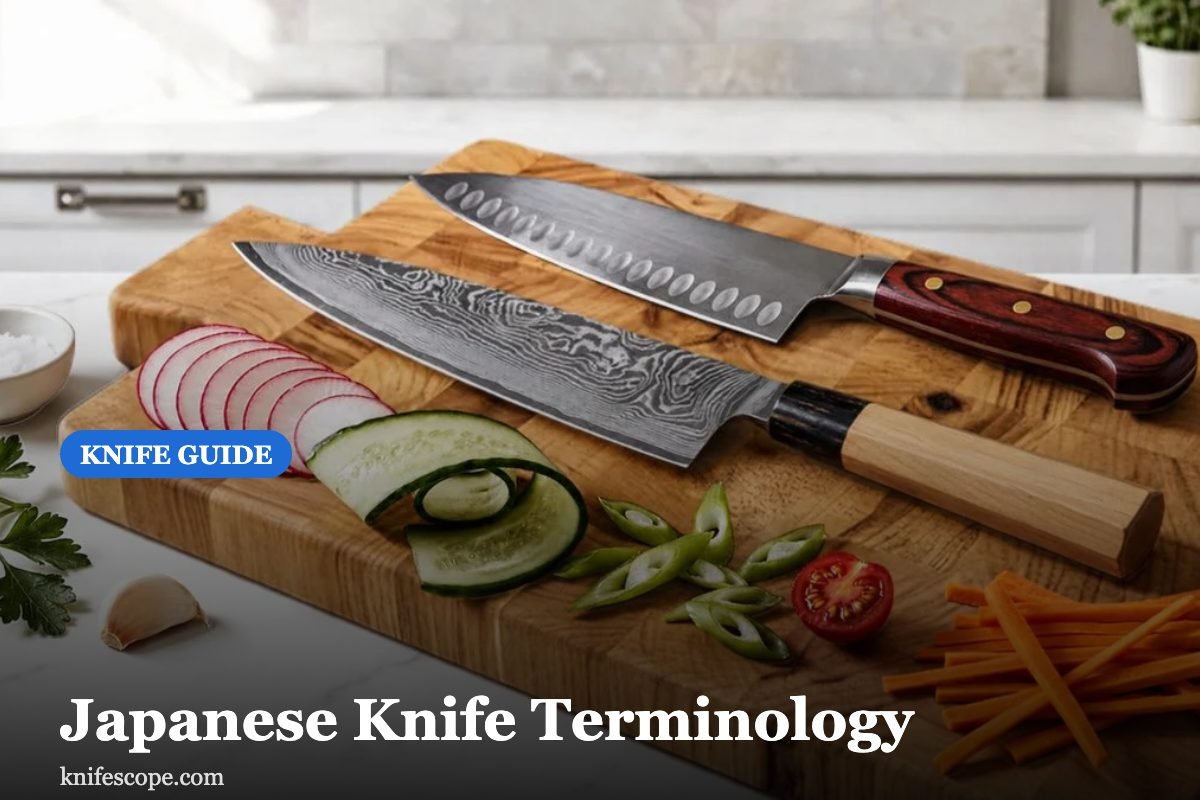
Shopping for a Japanese knife can feel like reading a foreign menu. Gyuto, kurouchi, kasumi, honyaki, wa handle: the listings assume you already know the words.
This glossary explains the terms you will actually see when buying, in plain English.
Why learning japanese knife terminology matters
Knowing japanese knife terminology helps you buy, use, and care for blades well. The right words make it easier to compare knives. You will spot quality and match the knife to tasks faster.
Clear labels and terms also protect you from hype. A seller may use Japanese-sounding words without true meaning. Learning key terms reduces mistakes and saves money.

Core Japanese knife terms every cook should know
Below are the most common terms you will see when learning Japanese knife terminology. Each term uses clear, simple definitions and a short example.
- Gyuto: A multipurpose chef's knife. Use it for meats, vegetables, and general prep.
- Santoku: A three-virtue knife for slicing, dicing, and mincing. Shorter and lighter than a gyuto.
- Nakiri: A vegetable knife with a straight edge. Best for thin slicing and push cuts.
- Usuba: A traditional single-bevel vegetable knife. Used by pro chefs for thin, clean cuts.
- Deba: A thick, heavy knife for fish and heavy cutting. Good for filleting and breaking bones.
- Yanagiba: A long single-bevel slicer for sashimi. It gives long, clean slices.
- Sujihiki: A double-bevel slicer similar to yanagiba but often westernized. Great for roasts.
- Petty: A small utility knife for paring and small tasks.
- Kiritsuke: A hybrid knife used by senior chefs. It mixes features of gyuto and usuba.
Parts of the knife, short list
- Ha: The cutting edge.
- Mune: The spine or back of the blade.
- Kissaki: The tip or point of a blade.
- Shinogi: The ridge line on some blades.
- Nakago: The tang that inserts into the handle.
- Habaki: The metal collar at the base of the blade.
- Tsuka or Wa-handle: The handle style; wa is traditional Japanese.
Common steel and finish words
- Shirogami: White steel, known for purity and sharpness.
- Aogami: Blue steel, holds a very sharp edge.
- Kasumi: A misty finish that means a softer cladding over hard core steel.
- Honyaki: A one-piece quenched and tempered blade made from a single steel.
- Kurouchi: A blacksmith finish that leaves the blade dark and rough.
People also ask
What is kataba and ryoba?
Kataba means single-bevel blade. Ryoba means double-bevel. Single-bevel is common on traditional Japanese knives. Double-bevel is common on western-style blades.
What is urasuki?
Urasuki is a hollow on the inside face of single-bevel blades. It reduces drag and helps thin slicing.

Blade profiles, grinds, and edge types
Blade shape and grind change how a knife cuts. These names are important in japanese knife terminology.
- Single-bevel (Kataba): Ground on one side only. It makes precise slices and is used in sushi knives.
- Double-bevel (Ryoba): Ground on both sides. It is easier to use and Maintain for most cooks.
- Convex (Hamaguri): A rounded edge that is strong and slices smoothly.
- Hollow ground: A concave grind that gives a very thin edge and low drag.
- Urasuki: The hollow on the non-edge side of single-bevel knives that reduces friction.
Edge styles and tips
- Flat grind: Good for chopping and veg work.
- Hollow grind: Excellent for slicing delicate items.
- Scalpel edge: Very thin and used for precise fish work.
My note from testing: single-bevel blades can out-slice double-bevel knives on fish and veg. But they need more skill to sharpen. For home cooks, a reliable double-bevel gyuto or santoku often gives the best mix of ease and performance.

Steel types, heat treatment, and hardness terms
Steel names appear often in japanese knife terminology. They affect sharpness, toughness, and care.
- Shirogami (White steel): Very pure iron carbon steel. Takes razor edges but can rust.
- Aogami (Blue steel): Alloyed with chromium and tungsten. Keeps edge longer than white steel.
- Stainless: Corrosion-resistant and low care, but may not reach the same sharpness as carbon steels.
- Honyaki: Made from one steel and quenched fully. Often harder and more brittle.
- Kasumi/clad: A hard core steel wrapped with softer steel to add toughness.
- Yaki-ire: The hardening or quench process during heat treatment.
- Tempering: Heating after quench to reduce brittleness and set toughness.
Hardness is measured in HRC. Higher HRC often means a longer lasting edge but harder to sharpen. Choose steel by use: higher HRC for fine slicing, lower HRC for heavy chopping.
Handles, construction, and common fittings
Handles and fittings are useful terms in japanese knife terminology. They affect balance and feel.
- Wa-handle: Traditional wooden handle, often octagonal or D-shaped.
- Yo-handle: Western-style full tang handle with rivets.
- Mekugi: A wooden peg that secures the tang in wa-handles.
- Habaki: The collar that locks the blade into the handle and sheath.
- Saya: The wooden sheath that protects the blade.
Pick a handle based on comfort and cutting style. I prefer wa-handles for light slicing and yo-handles for heavy use. Test feel first when you can.

Care, sharpening, and maintenance terms
Good maintenance preserves edge and value. These care terms come up in japanese knife terminology.
- Toishi: Japanese whetstone used For sharpening.
- Nagura: A small stone used to create slurry on finer stones.
- Gingi? Avoid—use simple terms like "honing" for daily touch-ups and "sharpening" for edge setting.
- Patina: A dark surface that forms on carbon steels to slow rusting.
- Rust prevention: Keep dry, use oil, and avoid acidic exposure.
Sharpening basics: start coarse to shape, then move to fine stones to refine the edge. Finish with light stropping or fine stone work. For single-bevel knives, learn correct angles and motion or seek a pro.
How to read markings and choose a knife
Sellers often stamp kanji on blades. These marks contain useful data. Learn to read key things.
- Steel type stamp usually lists a shorthand like "青紙" (aogami) or "白紙" (shirogami).
- Maker mark shows brand or smith and can be a sign of pedigree.
- "Made in Japan" tells origin but not quality. Look for steel name and construction type like honyaki or clad.
- Blade type stamp may list the knife type, such as gyuto, deba, or yanagiba.
When choosing, think of tasks, skill level, and care. I advise new buyers to start with a double-bevel gyuto or santoku. Test balance and edge feel in hand if possible.
Personal tips and common mistakes to avoid
I have sharpened and used many knives. Here are simple tips from experience.
- Do not soak a wa-handle in water. It swells and can split.
- Match steel to your care habits. If you avoid polishing and oiling, choose stainless.
- Learn basic sharpening. A dull knife is more dangerous than a sharp one.
- Practice cutting technique before buying a specialty single-bevel knife.
A mistake I made early on was buying a high-HRC honyaki without sharpening skills. It cut brilliantly but I could not maintain the edge at home. I returned to a more forgiving steel until my skill improved.
Quick glossary
- Gyuto: Japanese chef knife, all-purpose.
- Santoku: “three virtues”, shorter all-rounder.
- Nakiri: flat-edged vegetable knife.
- Bunka: all-rounder with an angled (reverse tanto) tip.
- Petty: small utility knife.
- Sujihiki: long slicer for meat and fish.
- Yanagiba: long single-bevel sushi knife.
- Deba: heavy single-bevel fish butchery knife.
- Kurouchi: rustic black forge finish left on the blade.
- Kasumi: misty finish, also a soft iron clad over a hard steel edge.
- Honyaki: knife made from a single piece of hardened steel, very high-end.
- Wa handle: traditional Japanese handle, usually octagonal or D-shaped.
- Shinogi: the line where the blade face changes angle.
- Hamon: the visible hardening line on some carbon blades.
Frequently Asked Questions of japanese knife terminology
What does "honyaki" mean?
Honyaki means the blade is made from a single piece of hard steel and fully quenched. It often offers great sharpness but needs careful maintenance.
What is "kasumi" finish?
Kasumi refers to a clad finish where a softer outer layer covers a harder core. It looks slightly cloudy and resists chipping.
What is the difference between gyuto and santoku?
Gyuto is a western-style chef knife for many tasks. Santoku is shorter and lighter, designed for mixed slicing and chopping.
How to say "knife" in Japanese?
"Knife" in Japanese is "hocho" or "bōchō" when speaking formally about kitchen knives. You will see "hocho" in many guides and labels.
Do Japanese knives rust easily?
Carbon steels like shirogami and aogami can rust if not cared for. Stainless steels resist rust but may not get as sharp as some carbon steels.
How often should I sharpen my Japanese knife?
Sharpen as needed based on use. Light honing can be done weekly; full sharpening on stones is often needed every few months for regular home use.
Conclusion
Learning a dozen terms makes Japanese knife listings much easier to understand. Bookmark this glossary and check it next time a product page throws unfamiliar words at you.
Maliha Khatun has spent 5 years hands-on testing Japanese knives for everyday home cooks. She has evaluated over 60 blades across nakiri, santoku, gyuto, and petty categories — scoring each on edge retention, steel quality, handle comfort, and value for money. She writes to help home cooks buy the right knife without the guesswork.
Expertise:Japanese Knives • Vegetable Knives • Product Reviews • Kitchen Efficiency • Knife Care