
KnifeScope is reader-supported. When you buy through links on this page, we may earn a small commission at no extra cost to you.
Chopping is the up-and-down motion you use for onions, herbs and most vegetables. The best chopping knives have a flat edge that meets the board fully and a tall blade that keeps your knuckles clear.
This list covers the knife styles that chop best and the models worth considering.
Our picks are based on manufacturer specifications, materials and long-term buyer feedback.

HOSHANHO Kitchen Knife in Japanese…
【High-End Japanese Steel Chef’s Knife】 HOSHANHO chef’s knife is made of Japanese high carbon steel 10Cr15CoMoV, 2x of the sharpness and durability of some other “premium” knives, and it owns…

HOSHANHO 7 Inch Nakiri Knife,…
【Ultra Sharp Blade】 Each Japanese nakiri knife is hand-polished by experts to achieve a sharp 15 degree edge angle. The ultimate sharp blade ensures every cut is effortless and smooth,…

HOSHANHO Cleaver Knife 7 Inch,…
【Excellent Sharp Edge】The sharp blade with 15° on each side allows for clean and precise cutting, and the hardness is as high as 58+2 HRC for maximum strength, flexibility and…
HOSHANHO 8″ Chef Knife

I’ve used this HOSHANHO 8″ chef knife daily for quick chopping tasks. The high carbon steel gives a keen edge that holds well. It feels balanced in my hand and cuts clean through tomatoes and onions. The handle stays secure even when my hands are wet.
For heavy-duty prep the blade performs efficiently. The tip lets me do fine work while the belly handles rocking chops. It does require careful maintenance to prevent rust spots over time. With proper care, the edge retention is impressive for the price.
Pros:
- Sharp high-carbon steel for precise chopping
- Balanced weight aids fast, controlled cuts
- Comfortable ergonomic handle reduces fatigue
- Good edge retention for extended use
- Versatile for vegetables, meat, and herbs
Cons:
- Requires hand-washing and drying to avoid rust
- May need professional sharpening after heavy use
- Blade finish can show patina with acidic foods
My Recommendation
This HOSHANHO 8″ chef knife is best for home cooks who want a reliable, sharp blade for everyday chopping. I recommend it if you prioritize edge performance and balance without spending a fortune. It handles the full range of prep tasks, from slicing sashimi-style vegetables to tackling poultry bones with care. For anyone upgrading from generic knives, this model brings professional feel and value.
| Best for | Why |
|---|---|
| Everyday home chefs | Balanced design and durable edge retention |
| Weekend meal preppers | Comfortable handle for long sessions |
| Budget-conscious cooks | High performance at a modest price |
HOSHANHO 7″ Nakiri

The HOSHANHO 7″ Nakiri is a vegetable specialist. Its straight edge and wide blade let me push and pull through dense squash and crisp roots. I love the flat profile for clean, full-length cuts that Preserve structure and texture. The wide face also scoops chopped items to the pan.
This nakiri shines when I need even, thin slices for stir-fry or salads. The high carbon stainless blend balances corrosion resistance with sharpness. It’s lighter than typical cleavers, so I maintain speed without fatigue. Small meat trimming works, but this is a vegetable-first tool.
Pros:
- Flat blade for uniform vegetable slices
- Wide blade doubles as a scoop
- Sharp edge that excels on produce
- Light weight promotes fast chopping
- Ergonomic handle improves control
Cons:
- Not ideal for heavy bone work
- Requires regular sharpening to keep razor finish
- Limited utility for tasks beyond vegetables
My Recommendation
If you cook lots of vegetables, the HOSHANHO 7″ Nakiri becomes indispensable. I recommend it as your go-to for fast, precise chopping and fine slicing of greens, carrots, and peppers. It makes prep cleaner and reduces waste by cutting thin, even pieces. For vegetable-focused cooks wanting a true japanese knife for chopping, this nakiri fits the bill.
| Best for | Why |
|---|---|
| Vegetable-focused cooks | Flat edge creates uniform slices |
| Salad and stir-fry makers | Wide blade scoops and transfers produce |
| Lightweight prep users | Speedy chopping with less wrist strain |
HOSHANHO 7″ Cleaver

This 7″ cleaver from HOSHANHO handles both vegetable chopping and light bone work. The thick spine gives confidence when I split joints and block ribs. At the same time the edge is thin enough to make clean veggie cuts without crushing. The weight helps one-stroke chops while keeping control.
The blade geometry suits multitasking in a busy kitchen. I appreciate the comfortable handle during longer sessions. If you want a single tool to chop, crush garlic, and cut through poultry, this cleaver covers it. Treat it well and it will stay sharp for many uses.
Pros:
- Sturdy spine for chopping bones and dense cuts
- Wide face for scooping and pounding
- Sharp edge that still slices vegetables cleanly
- Robust construction for heavy use
- Good value for a multifunction chopper
Cons:
- Heavier weight may tire some users
- Not for fine slicing tasks
- Requires safe handling and storage
My Recommendation
I recommend the HOSHANHO 7″ Cleaver for cooks who want a workhorse for prep and light butchery. I find it ideal for breaking down poultry and chopping dense vegetables. The blade makes tough jobs quicker and keeps your workflow smooth. If you need a reliable japanese knife for chopping and basic splitting, this cleaver is a solid pick.
| Best for | Why |
|---|---|
| Home butchers | Thick spine for joint work |
| Multi-task kitchens | Handles crushing and chopping well |
| Value seekers | Durable at a modest price |
Imarku 7″ Santoku Knife
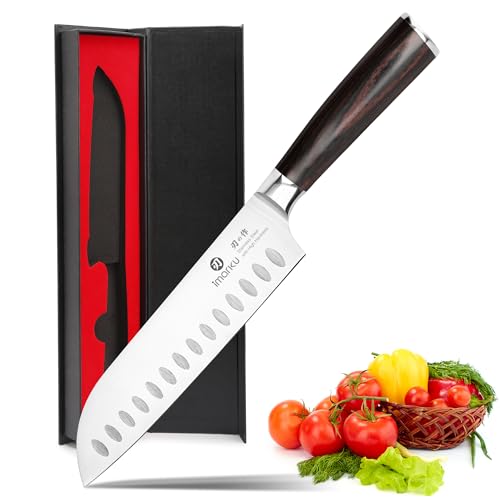
I use the imarku 7″ Santoku when I need quick, clean chops and slices. It has a classic santoku shape that excels at push-cutting and mincing herbs. The hollow-grantons reduce sticking on wet or starchy foods. The blade balance makes quick work of prep without strain.
It’s compact enough for tight kitchens but powerful enough for most tasks. The high carbon composition sharpens well and stays honed with light maintenance. I found it versatile for fish, vegetables, and boneless meat. For apartment cooks, it’s a dependable all-rounder.
Pros:
- Hollow-granton edge reduces food sticking
- Compact size suits small kitchens
- Sharp, easy-to-hone steel
- Good for fine mincing and thin slicing
- Comfortable grip for quick prep
Cons:
- Not designed for heavy bone work
- Edge can chip if misused
- Handle finish may show wear over time
My Recommendation
The imarku 7″ Santoku is a great choice for cooks who want an agile japanese knife for chopping and everyday slicing. I recommend it to apartment cooks and those who value a compact, sharp tool. It shines on herbs, fish, and vegetable prep and keeps cleanup easier thanks to the grantons. Overall, it provides excellent performance for its size.
| Best for | Why |
|---|---|
| Apartment cooks | Compact and versatile for small spaces |
| Herb and fish prep | Thin edge and grantons reduce sticking |
| Beginners | Easy to handle and maintain |
DDF 7″ Santoku Knife

The DDF 7″ Santoku offers a secure, non-slip handle that I appreciate when my hands are wet. The blade profile supports a short rocking motion and push cuts with equal ease. It’s well suited for thin slicing and dicing vegetables. The stainless blend resists corrosion and is low-maintenance.
I found the DDF performs reliably in rushed prep. It holds a useful edge and resharpens easily at home. This santoku is a solid tool for someone who wants a dependable japanese knife for chopping without extensive care needs. It’s also an affordable option for busy kitchens.
Pros:
- Non-slip handle for secure grip
- Low-maintenance stainless composition
- Good edge for thin slicing and dicing
- Well-balanced for quick prep
- Resharpens easily at home
Cons:
- Not ideal for heavy bone cutting
- Edge may need frequent honing under heavy use
My Recommendation
I recommend the DDF 7″ Santoku for cooks who want a low-maintenance japanese knife for chopping and routine prep. I use it when speed and grip safety matter most. It’s great for families or busy cooks who may not time for detailed blade care. The overall value and ease of use make it a go-to in my line-up.
| Best for | Why |
|---|---|
| Busy families | Durable and low maintenance |
| Everyday meal prep | Secure grip and balanced feel |
| Home cooks | Easy to sharpen and use |
Matsato 6.3″ Chef Knife

The Matsato 6.3″ chef knife is a nimble tool I reach for when I want speed and control. Its shorter length keeps cuts compact and precise, perfect for fine garnishes and quick dicing. The Japanese steel sharpens to a fine edge that stays useful through most sessions. The balance is excellent for one-handed prep tasks.
For BBQ or small family meals, it’s ideal. The blade gives clean, consistent slices and avoids tearing delicate meats. If you want a small, high-performing japanese knife for chopping in tight spaces, this Matsato fits well. It’s an elegant and efficient choice.
Pros:
- Compact length for precision work
- Excellent balance for control
- Sharp edge for clean slicing
- Good for small kitchens and BBQ prep
- Comfortable for long use
Cons:
- Small size limits large roasts or big veg
- Not ideal for heavy cleaving
My Recommendation
I recommend the Matsato 6.3″ Chef Knife for cooks who want a compact japanese knife for chopping and fine prep. I use it when accuracy matters and counter space is tight. It’s great as a second knife or for cooks who favor quick, precise cuts. The value is high for its performance level.
| Best for | Why |
|---|---|
| Precision tasks | Short blade allows exact cuts |
| Small kitchens | Easy to maneuver in tight spaces |
| BBQ prep | Clean slices for meat and veg |
Huusk Serbian Chef Knife

The Huusk Serbian chef knife blends Japanese edge geometry with a robust forged body. I noticed it excels at meat and outdoor tasks thanks to the full tang and sturdy profile. The sheath makes it handy for camping or grilling. It’s heavier but offers confidence for cutting through dense material.
At home I use it for large roasts and thick-skinned ingredients. The blade’s heft gives momentum for tougher chops, while the edge still slices cleanly when used properly. It’s a durable tool for cooks who want a serious japanese knife for chopping in both kitchen and outdoor settings.
Pros:
- Full tang construction for strength
- Forged build withstands heavy use
- Sheath helps safe transport and storage
- Performs well on large meats
- Good all-weather option for outdoor cooking
Cons:
- Heavier than standard chef knives
- May be overkill for simple salad prep
- Requires careful handling and storage
My Recommendation
I suggest the Huusk Serbian Chef Knife for cooks who need a rugged japanese knife for chopping large cuts and outdoor work. I rely on it when I break down big roasts or when grilling outdoors. It’s a dependable tool for heavy tasks and travel. If you want power and durability in one blade, this is worth considering.
| Best for | Why |
|---|---|
| Outdoor cooks | Sheath and robust build for travel |
| Heavy-duty tasks | Full tang and forged strength |
| Meat lovers | Handles thick cuts with ease |
EANINNO 8″ Chef Knife

The EANINNO 8″ Chef Knife impressed me with a refined bubinga handle and sharp edge. The wood grip feels premium and sits comfortably in my palm for long prep sessions. The blade is wide, letting me chop and transfer ingredients easily. It presents a professional look that performs well in practice.
Functionally, it handles vegetables and meat with equal skill. The steel combination balances corrosion resistance and edge retention. I noticed minimal stickiness when slicing potatoes and cucumbers. For cooks wanting a polished feel and strong performance, this EANINNO knife delivers.
Pros:
- High-end bubinga handle for comfort
- Sharp blade with good edge stability
- Wide blade for scooping and transfer
- Versatile for vegetables and meat
- Professional aesthetic
Cons:
- Wood handle needs occasional oiling
- Edge can dull faster under rough use
My Recommendation
I recommend the EANINNO 8″ Chef Knife for cooks who want a stylish, high-performing japanese knife for chopping and presentation. I use it when I want both form and function for dinner parties or daily prep. The handle adds a premium feel while the blade delivers clean cuts. It’s an excellent blend of style and reliability.
| Best for | Why |
|---|---|
| Entertaining cooks | Attractive handle and presentation-ready blade |
| Versatile home chefs | Performs well on varied ingredients |
| Gift buyers | Premium look and feel for gifting |
Huusk 2-Piece Set

The Huusk 2-piece set pairs a nakiri with a cleaver, giving me two focused tools for full prep. The hand-forged construction delivers a satisfying edge right out of the box. I use the nakiri for delicate vegetable work and the cleaver when I need to handle meat and bones. The set covers almost every chopping scenario.
It’s a smart starter kit for cooks building a serious knife collection. Each blade feels purposeful and well balanced. I found the pair reduced the need to swap tools mid-prep. For value and versatility, this set performs well in both home and pro kitchens.
Pros:
- Two knives cover wide range of tasks
- Hand-forged edges for solid initial sharpness
- Quality construction feels durable
- Reduces tool swapping during prep
- Good gift option for serious cooks
Cons:
- Set requires proper care to maintain edges
- Cleaver may be heavy for some users
- Limited to the two included blade types
My Recommendation
I recommend the Huusk 2-Piece Set for cooks who want a complete japanese knife for chopping kit right away. I use this set when I need both precise vegetable cuts and reliable meat chopping. It’s efficient and saves time by matching tasks to the right blade. For someone building a kitchen basics collection, this set is an excellent choice.
| Best for | Why |
|---|---|
| Home cooks building a kit | Two blades cover most prep needs |
| Gift buyers | Ready-to-use, well-made set |
| Small professional kitchens | Efficient pairing for quick prep |
Matsato 5.8″ Cleaver

The Matsato 5.8″ cleaver is a compact chopper that works well in home kitchens. Its shorter length makes it more maneuverable while still offering power for dense vegetables. I use it for quick but steady chops and light bone trimming. The blade thickness balances weight and control effectively.
It’s an approachable cleaver for cooks who want a strong tool without the size of a full cleaver. I find it ideal for day-to-day work and small roasts. The edge takes and keeps a good bevel with normal maintenance. It’s a handy addition to any Japanese knife for chopping lineup.
Pros:
- Compact cleaver size for easy handling
- Good for dense vegetables and small bones
- Balances power with control
- Easy to store compared to larger cleavers
- Solid edge retention for home use
Cons:
- Not suitable for large butchery jobs
- Blade care needed to avoid chips
My Recommendation
I recommend the Matsato 5.8″ Cleaver for cooks wanting a Smaller japanese knife for chopping and moderate cutting tasks. I appreciate its maneuverability and suitability for home kitchens. It’s great when you want a cleaver’s power without the bulk. The compact size and robust performance make it a useful go-to tool.
| Best for | Why |
|---|---|
| Small kitchens | Compact size fits tight spaces |
| Home meal prep | Handles dense veg and small bones |
| First-time cleaver users | Approachable size and weight |
Best shapes for chopping
- Nakiri: completely flat edge, ideal for vegetables.
- Santoku: mostly flat with a slight curve, a good all-rounder.
- Chinese cleaver: tall, heavy and fast for big batches.
- Gyuto: more curve, better for slicing, still chops well with a push cut.
FAQs Of japanese knife for chopping
What makes a Japanese knife good for chopping?
Japanese knives use thinner steel and sharper bevels. That gives cleaner cuts and less crushing. The blade geometry Favors precision, which speeds up chopping. A well-made japanese knife for chopping reduces waste and improves texture.
How should I maintain a Japanese chopping knife?
Hand-wash and dry immediately. Hone regularly with a fine ceramic or steel rod. Sharpen on a whetstone when the edge dulls. Store in a block or sheath to protect the blade and keep it safe.
Can I use a Japanese chopping knife on bones?
Most Japanese knives are thin and not designed for heavy bones. Use a cleaver-style model for light bone work. For big bones, choose a dedicated butcher’s cleaver or saw to avoid damaging the blade.
Are Japanese knives harder to sharpen?
They can require a whetstone for best results because of the fine edge. Once you learn basic whetstone technique, sharpening is straightforward. Regular honing reduces the need for frequent sharpening sessions.
Which knife is best for everyday chopping?
A chef’s or santoku blade around 7–8 inches is the best everyday choice. It balances length, control, and versatility. I often recommend a 7–8″ japanese knife for chopping when people want one reliable all-purpose tool.
Final verdict
If chopping vegetables is most of your prep, a nakiri or santoku will feel faster and more natural than a curved chef knife. Keep the edge sharp and use push cuts rather than rocking.
Maliha Khatun has spent 5 years hands-on testing Japanese knives for everyday home cooks. She has evaluated over 60 blades across nakiri, santoku, gyuto, and petty categories — scoring each on edge retention, steel quality, handle comfort, and value for money. She writes to help home cooks buy the right knife without the guesswork.
Expertise:Japanese Knives • Vegetable Knives • Product Reviews • Kitchen Efficiency • Knife Care