
KnifeScope is reader-supported. When you buy through links on this page, we may earn a small commission at no extra cost to you.
Most cooks learn one grip and use it for everything. That works until you spend an hour on prep and your wrist starts to ache, or you try fine detail work and the knife feels clumsy.
Different tasks call for different grips. This guide matches each common grip to the job it does best, and covers the small adjustments that take strain off your hand.
Why knife grip techniques matter
Good knife grip techniques keep you safe, speed up prep, and give cleaner, more consistent cuts. Grip affects leverage, blade angle, and how much force you need. Poor grips lead to slips, uneven slices, and injuries.
People who master knife grip techniques find tasks faster and less tiring. That matters in a busy kitchen and at home. This article covers common grips, when to use each, training drills, ergonomics, and quick fixes.
Common knife grip techniques and when to use them
Below are the grips every cook should know. Each grip fits different tasks and blade types. Learn them slowly and practice deliberately.
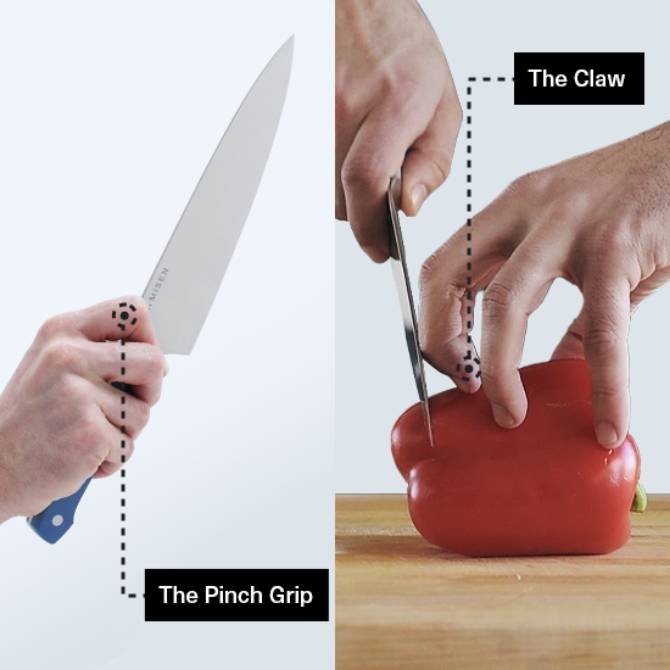
- Pinch grip: Hold the blade between thumb and side of index finger, with the rest of the fingers wrapped around the handle. This grip gives the best control for precision cuts and rocking motions.
- Handle (chef's) grip: All fingers wrap on the handle with thumb on the side or top. Good for Heavy chopping and people used to traditional handles.
- Palm grip: Blade shaft sits against your palm and fingers curl forward. Useful for short, strong cuts and utility knives.
- Reverse grip: Blade points down or up while the thumb locks the spine. Reserved for tactical use or certain outdoor tasks; not common in kitchen work.
- Saber grip: Handle held in a fist with thumb wrapped around. Works for large cutting tasks and some outdoor scenarios.
Choosing the right grip depends on task, blade length, and your wrist mobility. Test grips on simple cuts first, then use them in full prep.

Step-by-step: how to perform the most useful grips
Practice each step slowly. Keep your fingers safe and your motions consistent. These steps show Precise knife grip techniques for daily work.
Pinch grip steps
- Place thumb on one side of the blade near the bolster.
- Place index finger on the opposite side of the blade.
- Wrap remaining three fingers around the handle.
- Keep the blade close to the knuckle line of your guide hand.
Handle (chef's) grip steps
- Slide all fingers onto the handle.
- Rest thumb on the side or top of the handle.
- Use the guide hand to pinch or steady the food.
- Use wrist and forearm motion to chop, not just fingers.
Reverse and saber grip precautions
- Only use when trained or in controlled outdoor settings.
- Keep the blade away from body and others.
- Maintain strong, steady wrist posture to avoid slips.
Practice these knife grip techniques slowly while standing still. Build muscle memory before rushing.
Safety, ergonomics, and body mechanics
Safety is central to knife grip techniques. Good posture, wrist alignment, and workspace setup reduce errors.
Key safety habits
- Keep the cutting board stable and at a Comfortable height.
- Tuck fingertips of the guide hand to form a claw.
- Use the non-dominant hand to steady food, maintaining a safe distance from the blade.
- Replace or sharpen dull blades; a sharp knife requires less force and is safer.
Ergonomic tips
- Stand with feet shoulder-width apart.
- Keep shoulders relaxed and elbows slightly bent.
- Use arm and Forearm motion for larger cuts; use wrist only for fine work.
- Rotate tasks to avoid repetitive strain from using the same grip all day.
These knife grip techniques will help reduce fatigue and prevent common injuries like tendonitis and wrist pain.

Training drills and exercises to improve grip and control
Simple drills build speed, accuracy, and confidence with knife grip techniques. Use these in short daily sessions.
Drills
- Basic dice drill: Slice a carrot into uniform dice while focusing on a steady pinch grip.
- Rocking motion drill: Use a chef's knife and practice a smooth rock from tip to heel.
- Speed-control drill: Time yourself on thin slices, then focus on maintaining even width rather than speed.
- Grip swap routine: Alternate between pinch and handle grips across a full prep session to learn when each helps.
Hand strength and mobility exercises
- Squeeze therapy ball for grip strength.
- Wrist rotations and stretches to maintain flexibility.
- Finger pinch holds using a soft clamp to condition the thumb-index hold.
I used these drills with culinary students. After two weeks, most students improved speed and cut uniformity. Practice with intention and short focused reps.

Knife selection, maintenance, and how they affect grip
Knife fit matters to any set of knife grip techniques. The right handle shape and blade balance can change which grip feels best.
Considerations when choosing a knife
- Handle circumference: Too thick or thin changes how fingers wrap.
- Balance point: A well-balanced knife feels lighter under the pinch grip.
- Bolster and heel features: They affect where the pinch or index finger rests.
- Blade length: Longer blades favor a pinch grip for control; shorter blades suit palm or handle grips.
Maintenance tips that support grip safety
- Keep knives sharp; sharpening preserves control and reduces slips.
- Clean handles to remove grease and maintain friction.
- Replace worn handles or loose rivets promptly.
A well-chosen, well-kept knife makes using knife grip techniques easier and safer every time.
Common mistakes and how to fix them
Avoid these pitfalls when you practice knife grip techniques. Small changes lead to big improvements.
Mistakes to watch for
- Over-gripping: Tight hands tire quickly and reduce fine control.
- Thumb too far back: Moves the balance and reduces precision in the pinch grip.
- Little or no guide hand use: Fingers exposed and cuts inconsistent.
- Dull blade: Forces extra pressure and unsafe techniques.
Quick fixes
- Relax the grip; focus on controlled motion, not brute force.
- Move thumb closer to the blade for better balance.
- Use the claw on the guide hand to protect fingertips.
- Sharpen blades regularly and wipe handles clean.
These adjustments make knife grip techniques safer and more effective quickly.

Personal experience: lessons learned and practical tips
I began with a strong handle grip and switched to the pinch grip when I wanted more control. Learning to change grips stopped many nicks and speeded my prep.
Lessons I’ll pass on
- Learn one grip deeply before adding others.
- Film yourself cutting to spot wrist or finger issues.
- Slow practice beats fast, sloppy work in the long run.
- Teach others by modeling safe knife grip techniques rather than only telling them.
These real-world tips come from years of teaching. They help new cooks build correct habits early.

Grip by task
| Task | Grip | Why |
|---|---|---|
| Chopping and slicing vegetables | Pinch grip (thumb and index on the blade) | Best control and least wrist effort |
| Heavy cuts, squash, cleaver work | Full handle grip | More power, safer for force |
| Fine detail, scoring, peeling | Point grip (index finger on spine) | Precision at the tip |
| Paring in the hand | Thumb-guided grip | Small, controlled cuts toward the thumb |
If your wrist or fingers hurt
- Raise or lower the board. The counter should sit roughly at your hip bone. Too high forces your wrist to bend.
- Loosen up. A death grip tires the forearm fast. Hold firmly enough to control the knife, no more.
- Round the spine. Sharp spine edges dig into the pinch-grip finger. A few strokes of fine sandpaper fix it.
- Sharpen. A dull knife makes you push harder, and pushing is what strains joints.
Quick Grip Chooser
Use the pinch grip for most tasks: thumb and forefinger pinch the blade just ahead of the handle, and the other fingers wrap the handle. It gives the best control. Use a relaxed handle grip when you need extra force for tough items, and keep the guiding hand in a claw shape.
Change your grip when the task changes. Fine work like trimming asks for a forward pinch, while heavy chopping benefits from a firmer hold farther back. For hand safety, pair this with our guide to finger placement while cutting.
Grip Troubleshooting: Fix Fatigue, Wobble and Slipping
If a knife feels awkward, the cause is usually small and fixable. Use these checks to find the problem.
Common problems and fixes
- The blade wobbles: move your pinch closer to the bolster and press your thumb and forefinger together firmly on the blade.
- Your wrist or forearm tires: loosen your grip, relax your thumb, and check that the board is not too low.
- The handle slips: dry your hands and the handle, and avoid cutting when they are oily or wet.
- Your knuckles hit the board: the handle may be too small, or you may be gripping too far back.
- You lose control of the tip: use a forward pinch and keep your guiding fingers in a claw.
Match the grip to the knife
Lighter Japanese knives often feel best with a pinch grip right at the heel, because the weight sits close to your hand. Heavier Western knives are comfortable slightly farther back. Cleavers and heavy choppers are held by the handle in a full grip, because you need more force for chopping.
Left-handed cooks
Left-handed cooks should check the blade grind. A single-bevel knife is ground for one hand, so buy the version made for your hand. Double-bevel knives work for either side.
A simple practice routine
Slice a cucumber slowly for two minutes at the start of a cooking session. Pay attention to where your hand rests and how tight you grip. Repeat this for a week and the correct position becomes automatic.
Frequently Asked Questions of knife grip techniques
What is the safest knife grip for beginners?
The handle (chef's) grip is easiest for beginners because it feels stable. Beginners should also use the claw on the guide hand to protect fingertips.
How do I transition to a pinch grip?
Start by placing thumb and index finger on the blade while keeping other fingers on the handle. Practice on slow, basic cuts until it feels secure.
Which grip gives the most precision for slicing?
The pinch grip gives the most precision for thin, consistent slices and for rocking motion with a chef's knife. It shortens the lever arm and improves blade feel.
How often should I practice knife grip techniques?
Short daily sessions of 5 to 10 minutes are more effective than long, infrequent practice. Consistency builds muscle memory and confidence.
Are special exercises helpful for grip strength?
Yes. Squeezing a soft ball, wrist stretches, and fingertip pinches improve the control needed for fine knife work. They also cut fatigue during long prep sessions.
Conclusion
Use the pinch grip for most prep, switch to a full handle grip when you need power, and save the point grip for detail. Combine that with the right board height and a sharp edge, and long prep sessions get a lot more comfortable.
Maliha Khatun has spent 5 years hands-on testing Japanese knives for everyday home cooks. She has evaluated over 60 blades across nakiri, santoku, gyuto, and petty categories — scoring each on edge retention, steel quality, handle comfort, and value for money. She writes to help home cooks buy the right knife without the guesswork.
Expertise:Japanese Knives • Vegetable Knives • Product Reviews • Kitchen Efficiency • Knife Care