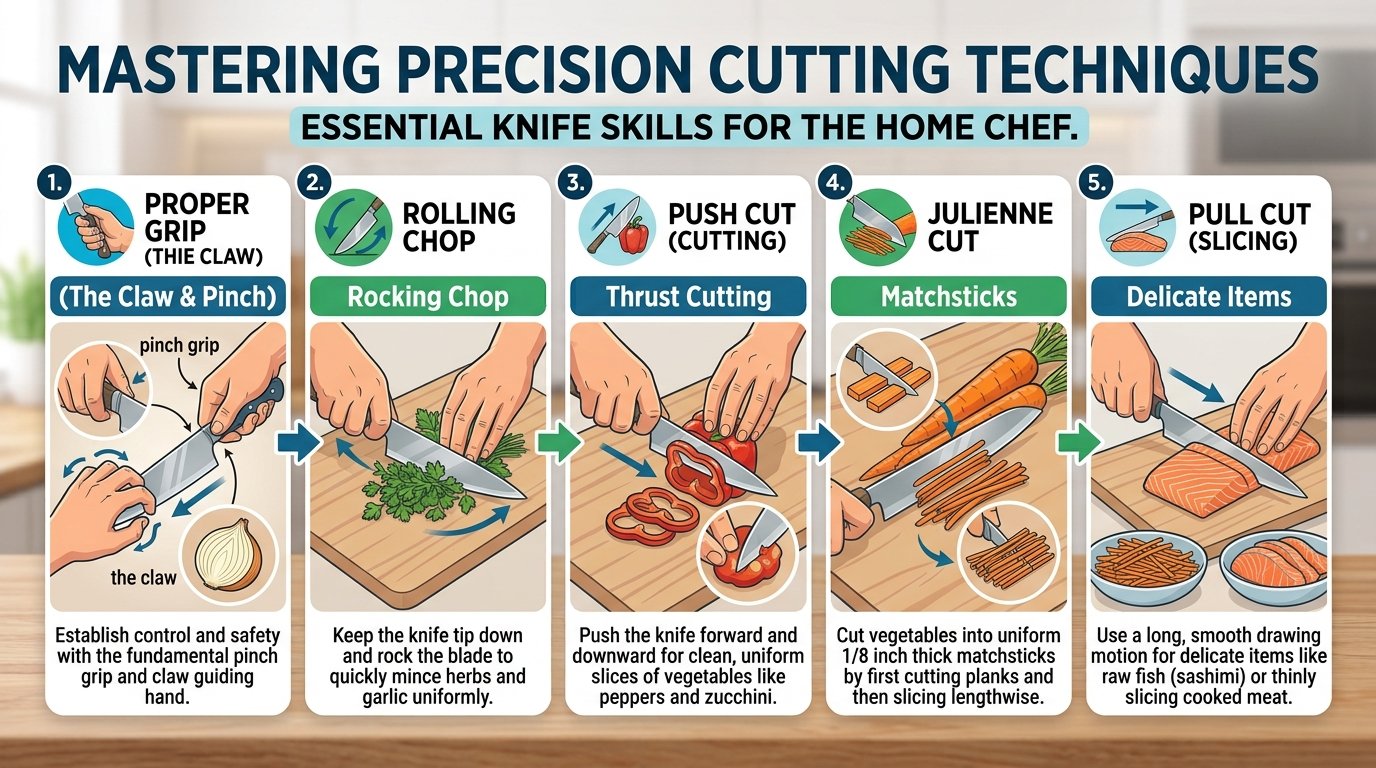
The claw grip is the way you hold food with your non-knife hand: fingertips tucked under, knuckles forward, so the side of the blade rests against your knuckles instead of your fingertips. It is the single most useful habit for avoiding cuts in the kitchen.
Most kitchen knife injuries happen to the hand holding the food, not the hand holding the knife. This guide shows how to form the claw grip, how to move it as you cut, the mistakes that put fingers at risk, and simple drills to make it automatic.

What is the claw grip?
The claw grip is a guide-hand position. You curl the fingertips of your non-dominant hand under, rest them on the food, and let the middle knuckles stand slightly forward. The flat side of the blade can then touch your knuckles while the edge stays well away from your fingertips.
It works together with how you hold the knife itself. Most cooks pair the claw with a pinch grip on the knife handle, which gives fine control of the blade.
Why the claw grip keeps you safer
- Fingertips stay out of the path: The edge meets knuckles and the flat of the blade, not exposed fingertips.
- The blade has a guide: Your knuckles act as a fence, so each slice lands in the same place and comes out the same thickness.
- Food stays stable: A firm, curled hand stops round or slippery food from rolling.
- It allows speed later: Once the position is automatic, you can cut faster without looking at your fingers.
How to do the claw grip: step by step
- Stabilize the food first. Cut a flat side on round items like onions, potatoes, or carrots and put that side down so nothing rolls.
- Curl your fingertips. Tuck the tips of your index, middle, and ring fingers under so the nails point down toward the board.
- Tuck your thumb behind. Keep the thumb behind your fingers, pressing the food from the back, never sticking out to the side.
- Bring the knuckles forward. Your middle knuckles should be the part of the hand closest to the blade.
- Rest the blade against your knuckles. Keep the tip or front of the blade on the board and let the flat of the blade touch your knuckles lightly. Do not lift the edge above knuckle height.
- Cut, then walk the hand back. After each slice, move your claw back by the thickness of the next slice. The knife follows the knuckles.

Common claw grip mistakes
- Flat fingers: Fingertips sticking out in front of the knuckles are the most common cause of cuts. Curl them back every time you reposition.
- Thumb out to the side: A thumb that pokes out ends up in the blade’s path at the end of the cut.
- Lifting the blade too high: If the edge rises above your knuckles, it can come down on top of your fingers. Keep the blade low and in contact with the knuckles.
- Rushing: Speed comes from consistency. Slow down until the hand position is automatic.
- Using a dull knife: A dull edge needs more force and is more likely to slip off the food. Keep knives sharp; see how often to sharpen knives.
Using the claw grip with different cuts
- Slicing and chopping: Use the standard claw and walk your hand back slice by slice. This covers most vegetable prep.
- Rocking cuts with herbs: Keep the claw on top of the pile and use your knuckles to guide the blade as it rocks.
- Dicing an onion: Hold the onion half with the claw for the vertical cuts. For horizontal cuts, press flat on top with your palm, fingers lifted and away from the blade.
- Small or short items: When the piece gets too small to hold safely in a claw, stop and set the end aside rather than cutting close to your fingers.
For the cutting motion itself, our guide to the bunka knife chopping motion pairs well with the claw grip.
Practice drills
- Dry run: Form the claw on a cucumber and move the flat of the blade against your knuckles without cutting, five times, to feel the contact point.
- Slow slices: Slice a cucumber or carrot into rounds at a slow, even pace, focusing only on walking the claw back evenly.
- Even thickness check: Lay your slices out. If they vary a lot, your hand is moving unevenly between cuts.
- Short and often: A few minutes during everyday cooking builds the habit better than one long session.
Other habits that prevent cuts
- Put a damp towel or non-slip mat under your cutting board so it cannot move.
- Keep the board clear. Push finished pieces aside with the spine of the knife, not the edge.
- Never try to catch a falling knife. Step back and let it drop.
- Store knives in a block, on a magnetic strip, or with blade guards, not loose in a drawer.
For more on safe knife habits, read our knife safety in the kitchen guide and these Japanese knife safety tips.
Frequently asked questions
Which hand uses the claw grip?
The hand that holds the food, so the left hand for right-handed cooks and the right hand for left-handed cooks.
Does the claw grip slow you down?
At first, yes. Once it becomes a habit it lets you cut faster, because the knuckles guide the blade and you do not need to watch your fingertips.
Can the knife cut my knuckles?
The flat of the blade should touch the knuckles, not the edge. Problems start when the edge is lifted above knuckle height or the knife is tilted toward the hand. Keep the blade upright and low.
What is the difference between the claw grip and the pinch grip?
The claw grip is for the hand holding the food. The pinch grip is a way of holding the knife, with thumb and index finger pinching the blade just in front of the handle. Most cooks use both together.
Is the claw grip safe for kids learning to cook?
It is the standard technique taught to beginners, but young cooks should learn it with adult supervision, a stable board, and soft foods first.
Conclusion
The claw grip protects the hand most likely to get cut: fingertips curled under, thumb tucked behind, knuckles guiding the blade. Practice it slowly on easy vegetables, keep your knife sharp and your board stable, and speed will follow. For more technique and buying advice, browse our knife guides.
Maliha Khatun has spent 5 years hands-on testing Japanese knives for everyday home cooks. She has evaluated over 60 blades across nakiri, santoku, gyuto, and petty categories — scoring each on edge retention, steel quality, handle comfort, and value for money. She writes to help home cooks buy the right knife without the guesswork.
Expertise:Japanese Knives • Vegetable Knives • Product Reviews • Kitchen Efficiency • Knife Care
Leave a Reply