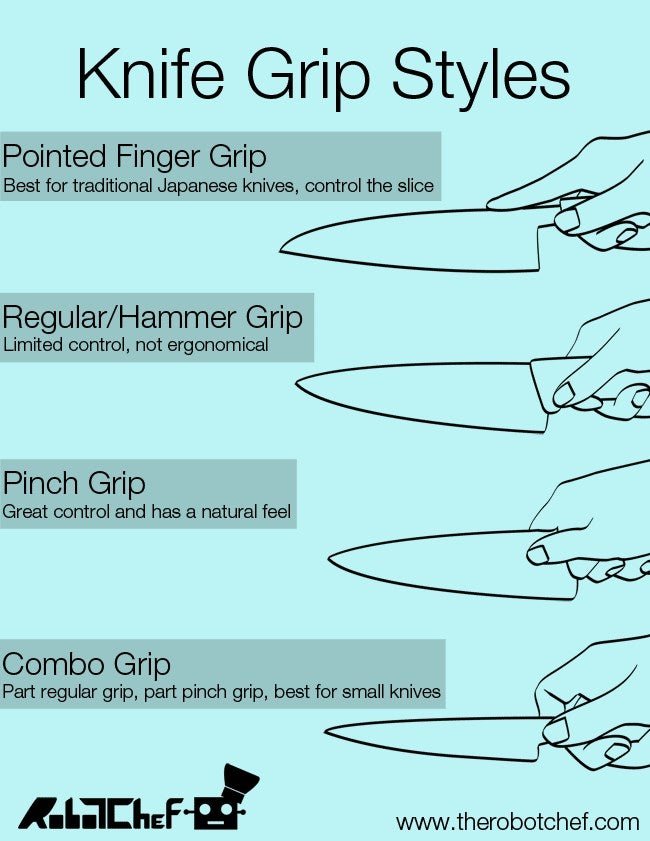
The pinch grip is a way of holding a kitchen knife: you pinch the blade just in front of the handle between your thumb and the side of your index finger, then wrap your remaining fingers around the handle. It gives more control than holding the handle alone.
Most professional cooks hold a chef’s knife this way because it puts your hand close to the knife’s balance point. This guide explains how to do the pinch grip correctly, when to use it, which knives suit it, and the mistakes that make it uncomfortable.

What is the pinch grip?
With a pinch grip, your thumb rests on one side of the blade and the side of your bent index finger rests on the other, right where the blade meets the handle. Your middle, ring, and little fingers wrap around the handle. The pinch, not the handle, does most of the steering.
The alternative is the handle grip (sometimes called the hammer grip), where all your fingers wrap around the handle. It feels natural to beginners but gives less control over the blade’s angle.

Why use the pinch grip?
- More control: Your fingers hold the blade itself, so small hand movements translate directly into the edge.
- Better balance: Your grip sits near the knife’s balance point, so the knife feels lighter and more stable.
- Straighter cuts: The blade is less likely to twist or lean, which helps keep slices even.
- Less wrist effort: With good balance, the knife needs less force from the wrist on long prep sessions.
The pinch grip is less suited to heavy work like splitting squash or chopping through bone. For those jobs a handle grip on a heavier knife or cleaver is more secure.
How to hold a knife with a pinch grip: step by step
- Find the balance point. Rest the knife on one finger where the blade meets the handle. That is roughly where your pinch should go.
- Place your thumb. Put the pad of your thumb flat on the side of the blade, just in front of the handle or bolster.
- Curl your index finger. Bend your index finger and place its side against the other face of the blade, opposite your thumb.
- Wrap the other fingers. Close your middle, ring, and little fingers around the handle. Grip firmly but without squeezing.
- Check the angle. The blade should hang straight down from your hand. If it tilts, adjust your thumb and finger so they press evenly.
- Add the guide hand. Hold the food with your other hand in a claw grip, fingertips tucked and knuckles guiding the blade.

Common pinch grip mistakes
- Pinching too far forward: Moving up the blade feels precise but throws off balance and puts fingers closer to the edge.
- Squeezing too hard: A death grip tires your hand and causes calluses. Hold firmly but relaxed.
- Index finger on the spine: Pointing the index finger along the top of the blade is a different grip. It can help on some delicate slicing, but it gives less lateral control for everyday chopping.
- Ignoring the guide hand: A good knife grip does not help if the other hand’s fingertips are flat in front of the blade.
- Using a dull knife: A dull edge forces you to push harder, which breaks down the grip. Keep the edge maintained; our honing vs sharpening guide explains the difference.

Which knives work best with a pinch grip?
- Chef’s knives and gyutos: The classic pinch-grip knives. Their blade height gives room for your fingers. See gyuto vs chef knife for the differences.
- Santoku, bunka, and nakiri knives: Tall blades are comfortable to pinch and well suited to push cuts.
- Petty and paring knives: Shorter blades can be pinched for detail work, though some cooks prefer a handle grip on very small knives. Our petty knife guide covers sizing.
- Bolster design: A full bolster that runs down to the heel can get in the way of your index finger. Knives with a half bolster or no bolster are usually easier to pinch.

Is the pinch grip uncomfortable at first?
Yes, for many people. The side of the index finger can get sore because it presses against the spine edge of the blade. This usually eases with practice and a relaxed grip. Knives with rounded or polished spines and chamfered choils are more comfortable, and some cooks protect the spot with a bandage while they adjust.
Practice drills
- Slice a cucumber or zucchini into even rounds, focusing on keeping the blade vertical.
- Cut an onion half into even slices, checking that the blade does not lean toward or away from your guide hand.
- Mince a small bunch of herbs with a rocking motion, keeping the pinch steady.
- Start slowly. Even, consistent cuts come before speed.
Frequently asked questions
Is the pinch grip safer than the handle grip?
It gives more control over the blade, which helps prevent slips. Safety still depends on a sharp knife, a stable board, and a proper claw grip on the guide hand.
Where exactly should my thumb go?
Flat on the side of the blade just in front of the handle or bolster, roughly at the knife’s balance point, opposite the side of your index finger.
Can left-handed cooks use the pinch grip?
Yes. The grip is the same with the hands reversed. Single-bevel Japanese knives come in specific left- or right-handed versions, but double-bevel knives work in either hand.
Should I use the pinch grip with every knife?
No. It suits chef’s knives and other tall blades for everyday prep. For heavy chopping or very small paring tasks, a handle grip can be more practical.
How long does it take to get used to the pinch grip?
It varies by person. Using it during your normal cooking is the quickest way to build the habit.
Conclusion
The pinch grip puts your hand at the knife’s balance point and your fingers on the blade, giving you steadier, more precise cuts. Pair it with a claw grip on the guide hand, keep your grip relaxed, and choose a knife whose bolster and spine are comfortable to hold. For more on safe technique, see our knife safety in the kitchen guide.
Maliha Khatun has spent 5 years hands-on testing Japanese knives for everyday home cooks. She has evaluated over 60 blades across nakiri, santoku, gyuto, and petty categories — scoring each on edge retention, steel quality, handle comfort, and value for money. She writes to help home cooks buy the right knife without the guesswork.
Expertise:Japanese Knives • Vegetable Knives • Product Reviews • Kitchen Efficiency • Knife Care
Leave a Reply