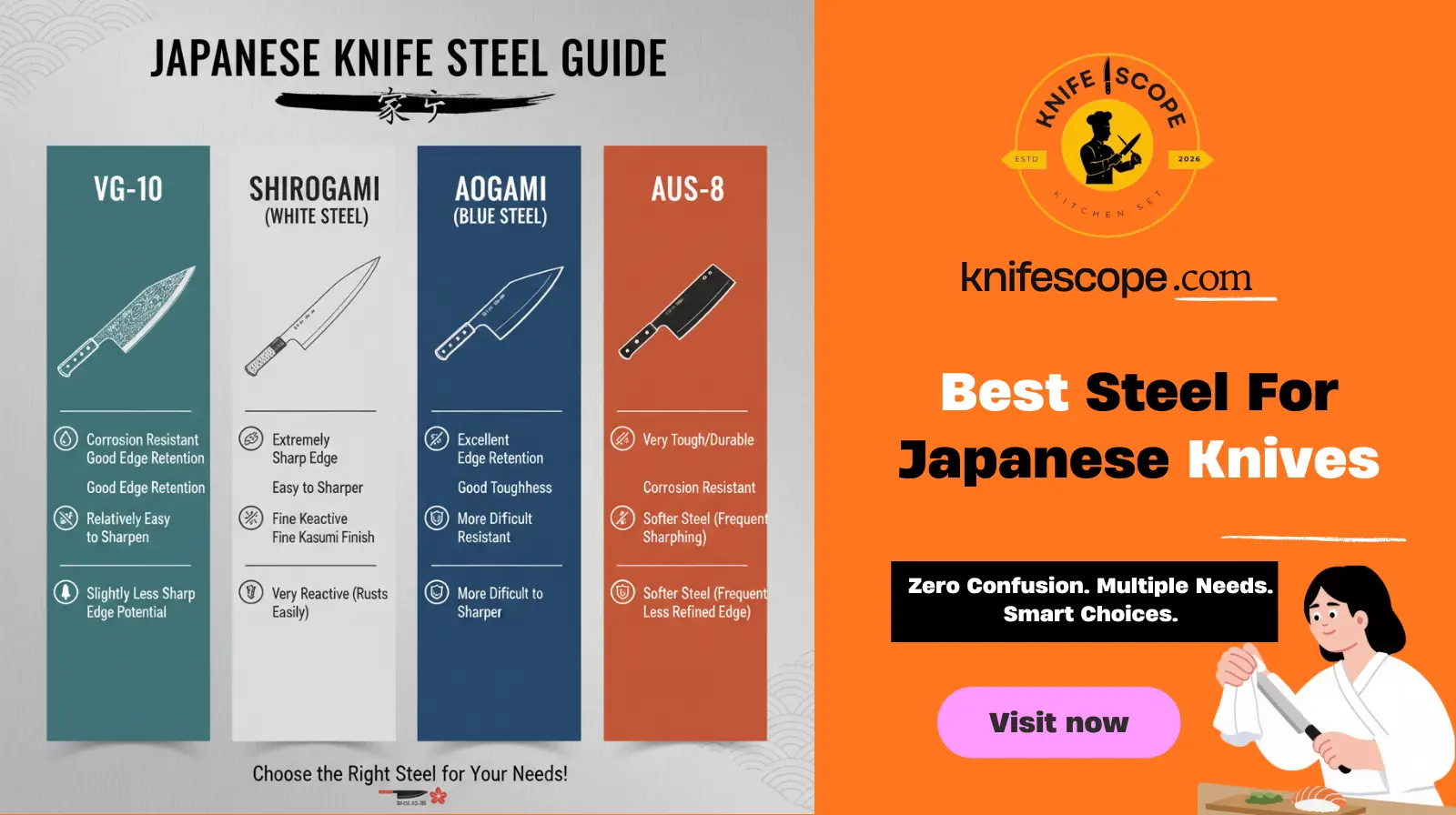
VG10 is a conventional stainless steel that is easy to sharpen and very forgiving. SG2 (also sold as R2) is a powder metallurgy stainless steel with better wear resistance, so it holds an edge longer. In independent testing, the two were similar in toughness and corrosion resistance at the same hardness.
Both steels come from Takefu Special Steel in Japan and are found in many Japanese kitchen knives. This comparison covers composition, hardness, edge retention, toughness, rust resistance, and sharpening, so you can decide which suits the way you cook and maintain your knives.

VG10 vs SG2 at a glance
| VG10 | SG2 / R2 | |
|---|---|---|
| Maker | Takefu Special Steel | Takefu Special Steel |
| Production | Conventional (ingot) steel | Powder metallurgy |
| Key alloy | About 1% C, 15% Cr, 1% Mo, 0.2% V, plus cobalt | Higher carbon, 14–15% Cr, 2–3% Mo, about 2% V |
| Edge retention | Good | Better |
| Toughness (same hardness) | Similar | Similar, slightly higher in one test |
| Corrosion resistance | Very good | Very good |
| Ease of sharpening | Easy | Moderate |
| Typical price | Lower | Higher |

What are VG10 and SG2?
VG10 belongs to Takefu’s “V Gold” series and dates back to around the late 1950s. It is a 1% carbon stainless steel similar in many ways to 440C, with an unusual cobalt addition. It became one of the most common steels in Japanese stainless kitchen knives, often as the core of a laminated or Damascus-clad blade.
SG2 (Super Gold 2) was developed by Takefu for cutlery, with a patent filed in 1991. It is made by powder metallurgy, which produces a finer, more even structure of hard carbides. It is sold as both SG2 and R2, and it is common in premium Japanese knives.
Composition and what it means
According to Knife Steel Nerds’ analysis, VG10 contains about 1% carbon, 15% chromium, 1% molybdenum, and 0.2% vanadium, plus cobalt. SG2 has more carbon, 14–15% chromium, 2–3% molybdenum, and about 2% vanadium.
- Carbon and vanadium form hard carbides that resist wear. SG2 has more of both, which is why it holds an edge longer.
- Molybdenum supports corrosion resistance. SG2’s higher molybdenum helps make up for its slightly lower chromium.
- Powder metallurgy gives SG2 a fine, uniform carbide structure. VG10, made conventionally, can have some larger carbides.
Hardness
Takefu’s charts list VG10 at around 60 HRC and SG2 at around 62 HRC. Knife makers choose their own heat treatment, so check the hardness listed for the specific knife. SG2 knives are generally sold harder than VG10 knives, which adds to SG2’s edge retention but makes the thin edge less forgiving of twisting or hitting bone.
Edge retention
SG2 has the advantage here. Its higher carbon and vanadium content give more wear resistance, so it stays sharp longer in slicing work. Knife Steel Nerds estimates SG2’s edge retention as above VG10 and 440C, though slightly below powder steels such as S35VN and Elmax. VG10 tested a little below 440C in CATRA slicing tests, which is still solid for a home kitchen.
Toughness
Toughness is a knife’s resistance to chipping and breaking. A common belief is that VG10 is much tougher than SG2, but testing does not support a large gap. In Knife Steel Nerds’ tests, both steels heat-treated to about 60.7 HRC measured 5.8 ft-lbs for VG10 and 6.5 ft-lbs for SG2. In practice, the bigger factors are the hardness a maker chooses and how thin the edge is ground.

Corrosion resistance
Both are true stainless steels. In Knife Steel Nerds’ distilled-water spray test, neither showed rust. In a 1% salt-water test, they performed similarly, and their overall corrosion ratings were nearly identical: 7.9 for VG10 and 7.8 for SG2 on a 10-point scale. Wash and dry either steel after use and they will stay rust-free.


Sharpening
VG10 is easy to sharpen on ordinary whetstones and polishes up much like 440C. SG2 takes a little longer because of its higher wear resistance, but it contains only a small amount of very hard vanadium carbide, so it is easier to sharpen than many other powder steels. Standard water stones work well for both. If you are new to stones, start with our guides on how to use a whetstone and the whetstone grit chart.
Which should you choose?
Choose VG10 if you:
- Want an affordable, low-stress stainless knife.
- Sharpen at home and want quick, easy results.
- Are buying your first Japanese knife.
Choose SG2 if you:
- Want an edge that lasts longer between sharpenings.
- Do a lot of slicing and fine prep.
- Are comfortable paying more and using careful technique on a harder edge.
Whichever steel you choose, the heat treatment, edge geometry, and how you use the knife matter as much as the steel name. For a wider view, see our knife steel guide and best steel for Japanese knives.


Caring for VG10 and SG2 knives
- Hand wash and dry the knife right after use.
- Use a wooden, rubber, or plastic cutting board, never glass or stone.
- Avoid twisting the blade, prying, or cutting frozen food and bones, especially with harder SG2 edges.
- Touch up the edge on a fine stone before it gets very dull. If a chip does happen, see how to fix a chipped knife edge.
Frequently asked questions
Is SG2 the same as R2?
Yes. SG2 and R2 are names used for the same Takefu powder steel.
Which holds an edge longer, VG10 or SG2?
SG2. Its higher carbon and vanadium content give it more wear resistance.
Is SG2 more brittle than VG10?
Not at the same hardness. In independent testing, SG2 was slightly tougher than VG10 at about 60.7 HRC. SG2 knives are often sold harder, though, and a harder, thinner edge is more prone to chipping if misused.
Does VG10 rust?
VG10 is stainless and performed similarly to SG2 in corrosion testing. Like any knife, it should not be left wet or in salty or acidic food for long periods.
Is SG2 worth the extra cost?
If you value longer edge life and sharpen less often, it can be. If you sharpen regularly and want an easy, forgiving knife, VG10 is excellent value.
Conclusion
VG10 and SG2 are both proven Takefu stainless steels. VG10 is easier to sharpen and costs less. SG2 holds an edge longer thanks to its powder metallurgy structure and higher alloy content. Toughness and rust resistance are close between the two. Pick the steel that matches your sharpening habits and budget, and look at the maker’s hardness and blade geometry too.
Source: test data and composition figures from Knife Steel Nerds, VG10 and Super Gold 2 – Takefu Stainless Steel Properties and History. The toughness and corrosion charts are from that source.
Maliha Khatun has spent 5 years hands-on testing Japanese knives for everyday home cooks. She has evaluated over 60 blades across nakiri, santoku, gyuto, and petty categories — scoring each on edge retention, steel quality, handle comfort, and value for money. She writes to help home cooks buy the right knife without the guesswork.
Expertise:Japanese Knives • Vegetable Knives • Product Reviews • Kitchen Efficiency • Knife Care
Leave a Reply